

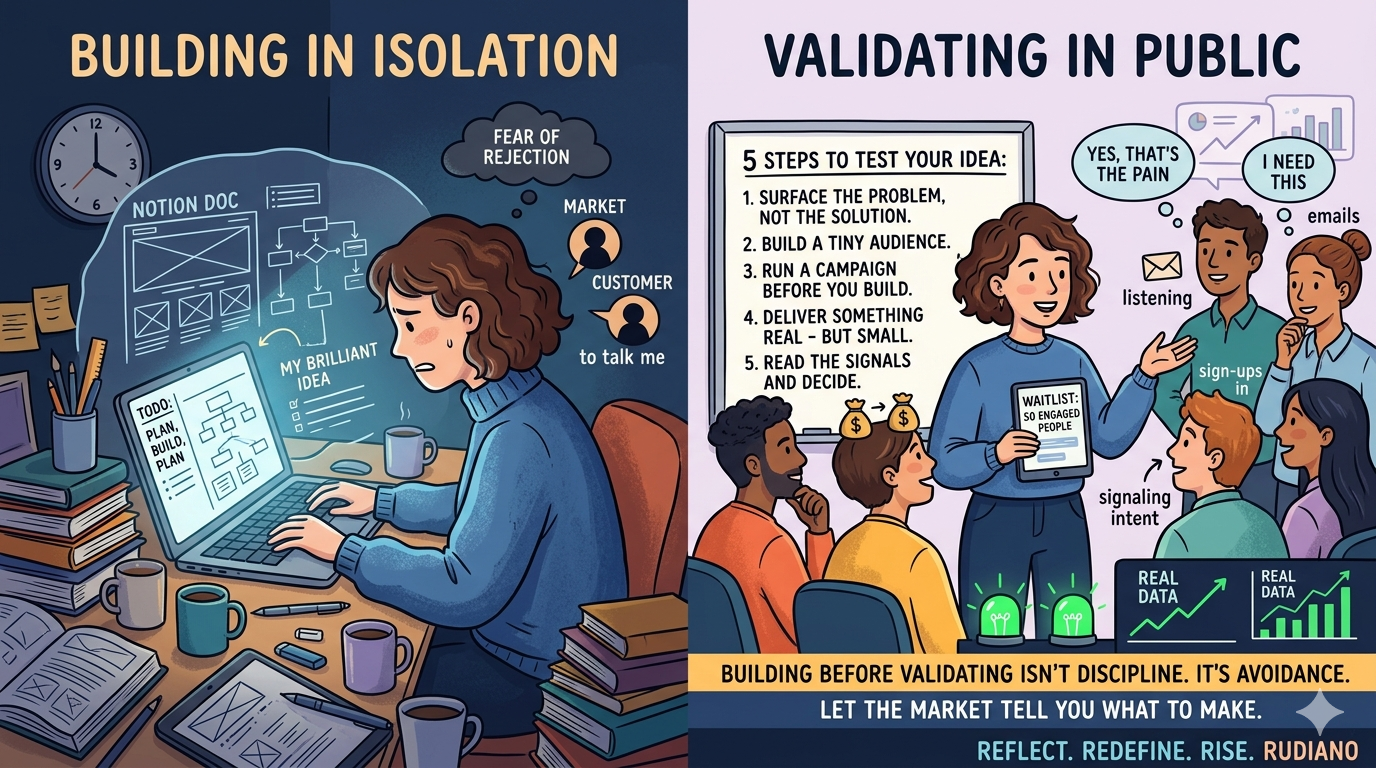
There’s a particular pleasure in the early stage of an idea. The designing. The mapping. The hours you spend arranging things in your head until they feel ready to exist in the world.
I know that pleasure well. A little too well, as it turns out.
Because here’s what I eventually had to admit to myself: all that building, all that careful preparation… some of it was genuine craft. And some of it was a very convincing way of avoiding the one thing that actually needed to happen first. Showing it to someone who might say “what the heck is that?!”
We don’t call it avoidance, of course. We call it not being ready yet. We call it getting it right. And we keep our heads down and keep building, because building feels like progress and progress feels safe,
I relate. There’s been projects I tinkered with until I felt rather optimistic about, right up until I went “Ta-da!” and got crickets.
The advice that sounds true and isn’t
There’s a version of creative wisdom that goes something like this: make something you believe in, make it well, and the world will find it. Build it and they will come.
I understand why that advice exists. It’s motivating. It feels like it’s honouring the work.
It’s also, in practice, how a lot of talented people end up with something finished and a room full of silence.
The world is not short of things. Whatever you’re making, there is already a version of it out there. Standing out is harder than it’s ever been. Releasing something good and hoping that’s enough: that stopped being a strategy a long while ago.
What the people who figured this out actually did
Jeff Walker, who spent years studying product launches, talks about something he calls the pre-prelaunch. It sounds like jargon. What it actually means is simple: talk about the problem publicly before you breathe a word about your solution. Watch who leans in.
That leaning is your signal.
Daniel Priestley takes it further. In Oversubscribed, his argument is that your job isn’t to release your work and then find people who want it. Your job is to create more desire than you have supply, before you have any supply at all. Campaign before you create. Measure the hunger before you cook the thing.
That shift in sequence changes everything.
What this actually looks like in practice
Forget the survey you send to friends who love you and want to be kind. That data will tell you what you want to hear. Here’s what works instead in 5 steps:
- Start with the feeling, not the product.
Write about the need. The frustration. The gap. As specifically and honestly as you can. Learn to articulate it. Post it everywhere. Send it to people. If it lands in silence, genuinely nothing, that’s information. Go back to the drawing board.
But if people respond, if someone says this is exactly it or I’ve been thinking about this too, you have something worth moving toward. The resonance for your product exists.
- Build a small audience around that feeling.
Don’t aim to go viral. A dozen people who feel your message deeply are worth more than five thousand who liked it somewhat.
Before your product exists, those people are the asset. They’ll tell you what they actually want. They’ll become your first customers. Build somewhere fixed for them to come back to: a newsletter, a simple page, something that isn’t entirely at the mercy of whatever the algorithm decided today.
- Run a campaign before you create anything.
This is the part that feels presumptuous. It isn’t. It’s the most honest move you can make. Tell your small, engaged group you’re working on something. One sentence. Ask who wants to know more. Ask what they’d pay. Open a waitlist. Not likes, not comments: emails, sign-ups, actual expressions of intent. Those are the signals that matter.
- Deliver something real, but small.
You’re still at the day job. Nobody’s quitting anything yet. But if the signals are there, make something you can actually deliver right now. A single piece to the people who asked. Ten copies. A live session for the handful who said yes. Something that puts what you make into the hands of someone who wanted it enough to say so. Small is fine. Real is the point.
- Read what comes back.
Now you have actual data. Did people show up? Did they ask when the next one is? Did they tell you what they’d want different, which means they cared enough to want it better? That’s your green light. Or it’s a redirect. Either way, you’re no longer guessing.
Why this matters if you’re still splitting yourself in two
I know what it feels like to build something on the side. The particular exhaustion of living in two worlds at once. The fear that if you test the idea and it doesn’t work, all your hopes will be crushed.
Here’s what I want to say to that fear: this process doesn’t kill your idea if it isn’t ready. It saves you. It saves you from six months of building something nobody wanted. It saves you from quitting before you had any real reason to, or staying long after you should have left.
Also, in the worse case scenario, you would still have added new strings to your bow. This is likely to open new doors, new opportunities.
And if the signals come back strong, if people lean in, sign up, pay, come back, tell their friends, it gives you something incredible. Not just income. Evidence. Proof that people want what you make. That proof has a way of quietly loosening the grip that fear has had on you for longer than you’d probably like to admit.
The hardest step is the first one that involves another person. Once someone pays you for what you make, you can build from there. You can work out what you need to live on, and how many people it takes to get there. After that, the question stops being what if this doesn’t work and starts being how far can this go.
That’s a much better question to be sitting with.
Reflect. Redefine. Rise!
Rudiano


Leave a Reply