

I can’t remember exactly when I was first asked what I wanted to do with my life. I don’t mean the whimsical question we ask toddlers for fun. I mean the time when that question carried real, heavy consequences.
Sixteen? Seventeen?
Do you remember when that question was put to you? Perhaps, like me, you were green in every sense of the word. You were likely too young to know if you had already discovered the thing you’d quietly return to for the rest of your life. Too young to know if there would be more than one thing, let alone if a common thread tied them together.
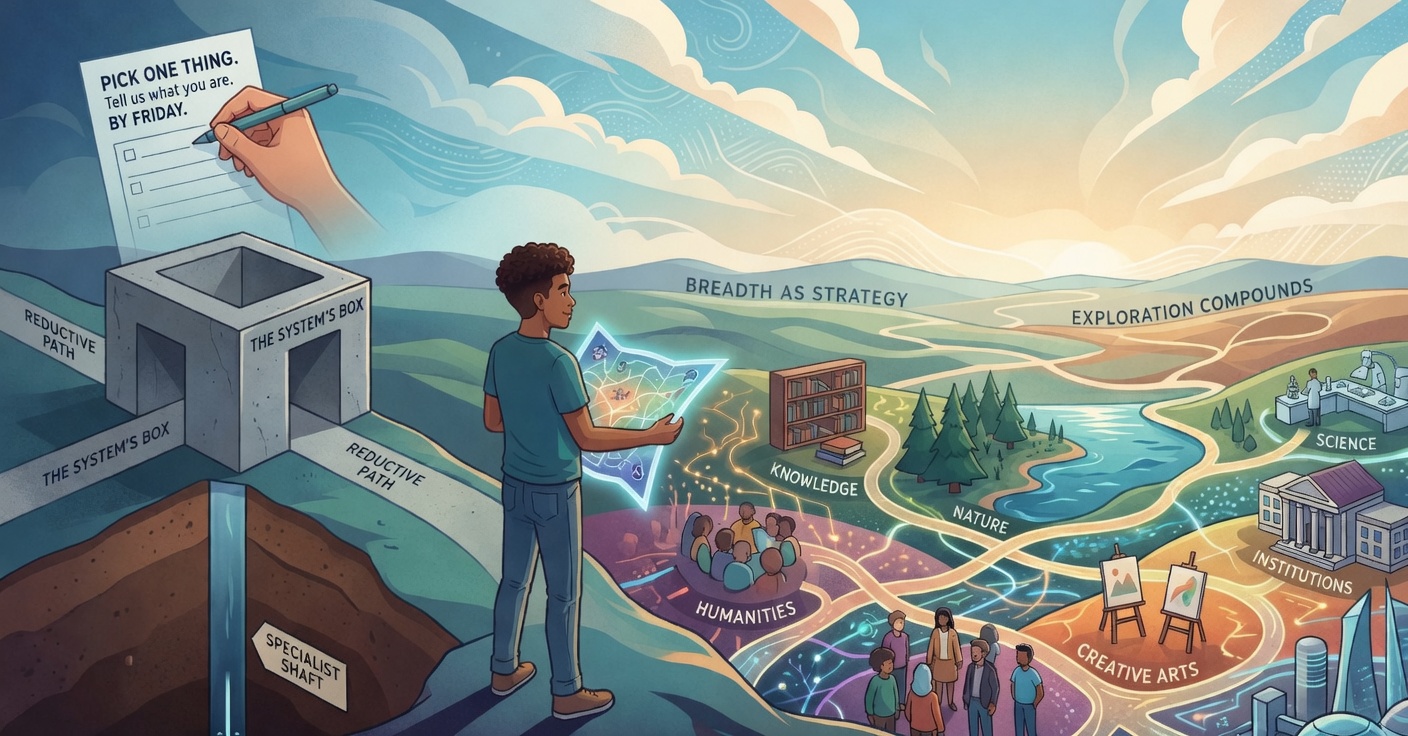
You hadn’t truly lived yet. But the world handed you a form and said, “Pick one thing. Tell us what you are. We need it by Friday.“
I have a few bones to pick with that deadline, primarily because it forces people to carry a guilt they don’t deserve.
This systemic rush is built on three flawed assumptions:
The Teenager Myth: You should know your ultimate destination while still a minor.
The Defect Narrative: If you fail to choose at the “prescribed” time, something is wrong with you. You’re slow, immature, or aimless.
The Poverty Threat: If you don’t fall in line, you are destined for a miserable, struggling life.
Deconstructing the Box
Let’s look at the system for what it is. It isn’t necessarily evil, but flawed. We may imagine the “pick one thing” model formalizes what teenagers naturally want. It doesn’t. It was an arbitrary framework designed to work in tandem with factories and the military.
Schools needed to categorize you to mass-produce obedient, specialized workers. When you didn’t fit neatly into a box, the system didn’t expand to accommodate you; it found you wanting. The objective was clear: we need all of you to get in line for the system to work.
In my case, I felt forced to settle for a single path before I had the necessary data to choose it. I was interested in more of the world than the system had room for. I needed to explore the perimeter before I could find my things. Yes, plural.
The Power of Crossing Domains
Here is the secret that escapes most people: exploration compounds. Every new domain you enter changes how you view the ones you already inhabit. That is how genuine insight works. You find patterns. You make connections. You build a consolidated worldview.
I’ve always been drawn to patterns: within people, civilizations, and ideas. Recently, I began studying how institutions are actually designed versus how they present themselves. It changed everything: how I view society and its many institutions. I feel even more aware that the surface is rarely the whole story.
Perhaps the best time to find your path is middle age, when we are wiser and traditionally more concerned with self-actualization than status or material gain.
Regardless, asking a child to choose a lifelong path is illogical. It forces us to defer to other people’s judgment, which is rarely a recipe for fulfillment.
The “Dilettante” stigma
There are words used to dismiss people like us. These are the people with multiple interests who refuse to commit prematurely or commit eternally:
Dilettante. Unfocused. Scattered.
We should be precise here, because there is a genuine distinction to be made. A dilettante dips in and out of subjects without seeking depth, often falling prey to the Dunning-Kruger effect, which is the confidence of the uninformed.
But one can be absolutely rigorous while pursuing several territories. In fact, that is what genuine intellectual commitment looks like: following curiosity wherever the evidence leads. Reflecting and making connections whether the conclusions are conventional or not.
That being said, our systems reward demonstrated specialism: a title, a degree, a single line on a resume. The system cannot measure the full range of what you’ve built inside yourself because that complexity is hard to categorize. It only rewards what it recognises. To function, society tries to average you out to what it already knows.
Breadth as Strategy
For the young, I offer this: alongside your formal studies, collect your own observations. Build your own blueprint. Your worldview is born from your reflections, not your curriculum.
This is a “shape” only you possess. It is a combination of domains and experiences that no one else has approached from your specific direction. This is your personal living map. It will take time for you to be able to articulate where it’s leading you. But listen to it. It talks to you.
To the “less young,” remember: a specialist can dig a very deep shaft. That depth has value. But the person who moves across the terrain, carrying knowledge between territories that don’t usually speak to one another, sees the whole field from above. They see the patterns the specialists are too close to notice. They can build things that require fluency in multiple “languages” at once.
Sit with this for a minute: What is the shape your life has taken? What connections exist between your seemingly disparate experiences? What is your resulting philosophy?
The institutions were never going to tell you that this was an option; it was a blind spot in their design. The form you signed at seventeen had no box for a “need to explore more.”
Some of us require more time and more territory to find our most meaningful contribution. That isn’t a character flaw.
It is time to expand beyond the reductive version of you that the system has created. Reconnect with your full essence: its length, its breadth, and all its glory.
If this made you think, read this one where I get more personal.
Reflect. Redefine. Rise.
R
Leave a Reply