

“Too big to fail“. We say it about banks. A bank gets reckless, starts to collapse, and someone rescues it anyway. Not because it earned it. Because too much now depends on it staying open.
That’s what happens to any institution once it gets large enough to be worth protecting. You’ve felt the same reflex somewhere smaller: the school that knew it needed extra teaching assistants but the budget had already been spent elsewhere, the hospital appointment cut to eight minutes because the schedule mattered more than you did, the job where you carried the extra work home quietly, for months, until the day the bottom line needed protecting and you were the easiest thing to cut. Same logic. Different building. The structure protects itself first. You absorb what’s left.
Every institution starts with a purpose, a mission. A school exists to educate children. A hospital exists to heal people. A company exists to make something people need. At the founding, the mission is the point.
Then the institution grows, and growth changes what it’s for.
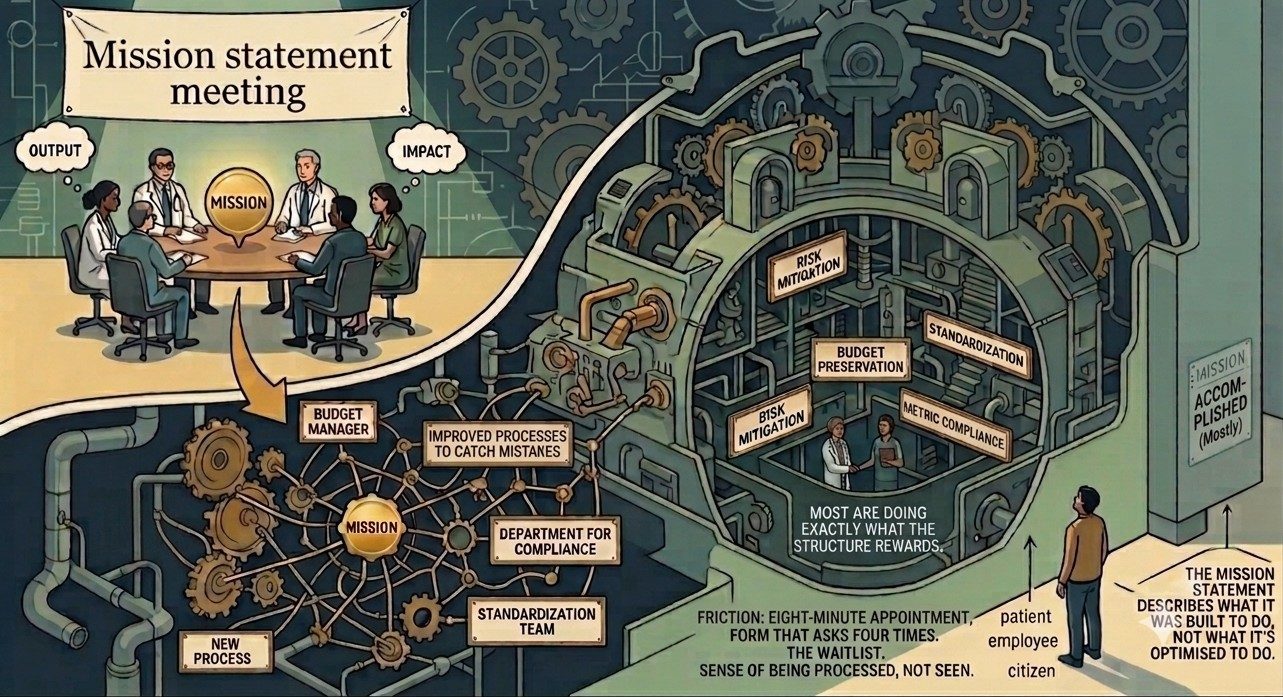
Through a thousand small decisions over time, each reasonable on its own, the winds start to change. Add a process to catch mistakes. Hire someone to manage the budget. Create a department to handle the department that handles the thing. Each step is defensible. Each step adds weight to a structure that now has to sustain itself.
At some point, quietly, the primary goal shifts. From “educating our children” to “keep schools running so we can keep educating children.” From “heal people” to “keep the hospital running so we can keep healing people.” From “keeping customers happy” to “keeping the lights on at all costs, so we keep the customers happy.” Then the second half of the sentence falls away.
It’s a very subtle change. Invisible to start with. The school system still teaches our children. The hospital still treats patients. The company still services its customers. But what these institutions optimise for, day to day, is their own continuity.
It makes sense. A large structure under pressure protects its own integrity first, because if it collapses, it can’t do anything for anyone. This logic also serves a particular power dynamic that I go over on Substack.
But here’s what all this means for you, standing outside the structure, relying on it to do what it promised to do:
The incentives flow toward the institution to do whatever keeps the structure stable. That’s the tacit priority. That’s what gets rewarded internally. That’s what gets someone promoted.
There will be friction. And the institution doesn’t absorb it first. The teacher does. The employee who has to follow the procedure no matter what. The patient. The citizen.
The people inside the institutions aren’t necessarily careless or unkind. Most are doing exactly what the structure rewards, because that’s what keeping their job requires.
Once you see this, a few things become clear.
You stop expecting the institution to perfectly live up to its mission statement. The mission statement describes what it was built to do. What it’s currently optimised to do is something else. The gap between those two things is what happens to large structures over time.
You stop taking the friction personally. The short appointment, the confusing forms, the policies, the feeling of being processed and not seen, the no until you ask three more times: none of it is a verdict on you. It’s the structure protecting itself and letting the cost land outward, not just you personally.
And you start making decisions that account for this, rather than decisions that assume the institution is exactly what it says it is.
The mission is often still in there somewhere. What’s changed is what the structure can deliver versus what it says it delivers. Seeing that gap clearly, without bitterness, is where navigation starts.
If you read till the end, then something must have landed! Click on one of the emojis below so I know 😉
Reflect, redefine, rise!
Rudiano
Leave a Reply