

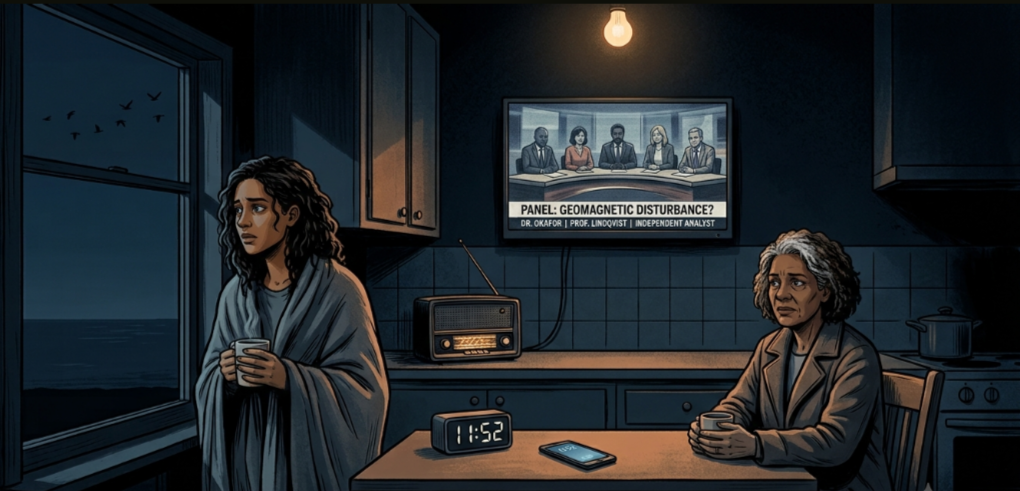
6:14 on her phone. Then 6:19. She dozed off. Next time she looked: 11:52 AM.
The hallway was pitched in a darkness that belonged to midnight, not late morning. She checked the phone again, half expecting a glitch. It held firm. Outside, the sky was black.
She checked the study clock, then her laptop. All three agreed. Either the clouds were doing something strange, or sunrise had come and gone while she slept. A whole day, packed up and put away.
Her mother sat at the kitchen table in her coat, paralyzed.
“I think the day already happened,” Sarah said. “While I was asleep. The whole thing got compressed.”
Her mother stared, blank. “Did you hear the radio?”
“I heard it.”
“They said not to adjust our settings.” A dry laugh. “As if we have settings.”
“They meant the telly.”
“I know what they meant, love. Who has a telly like that anymore? Makes you wonder who they were talking to.”
Neither of them checked whether the night would behave any better than the day had. It didn’t. The dark held for what felt like days, though the news insisted it was only one long night.
Then the sun eventually burst over the horizon… and refused to set.
“Just an odder day,” the radio host said the next morning, pleased with himself.
After what felt like close to 2 days of continuous sunlight, the sea did something Sarah’s father had never seen in forty years fishing the coast. It retreated past the lowest tide lines, stranding trawlers half a mile from shore, then came back in a surge that bent the promenade railings.
That afternoon, a panel appeared on television to explain it away.
Three people behind a curved desk, blinding lights draining the colour from their faces.
Sarah’s father read the lower thirds aloud.
“Dr. Okafor, Tidal Systems. Professor Lindqvist, Chronodynamics. And this one just says Independent Analyst. Hmmmm. Bit of a demotion.”
“Dr. Okafor,” the host said, “your appraisal?”
Okafor reached for his water glass before he’d said a word, set it down without drinking. “A textbook case of accelerated evaporation, resulting in an altered basin density. Not really an anomaly. All consistent.”
“Professor Lindqvist?”
Lindqvist pushed her glasses up with two fingers. “I’d disagree on the specifics. But the point is, this was self-resolving. Tide’s back to normal. No reason to alter your routines.”
They traded rebuttals until the segment ran short. The host turned to the end of the desk. “And for balance, our independent analyst.”
He leaned forward. “This wasn’t a standard tidal event. It’s rather the tail end of a chain that started weeks ago.”
“With respect,” Okafor said, reaching for the glass again, “that’s a dramatic reading of a basic fluid-density problem.”
“Fluid density doesn’t cause a near tsunami.”
“It explains enough for tonight’s broadcast.”
Lindqvist adjusted her glasses. “The public needs expertise, not speculation. The facts are that I see no reason to alter our routines.”
Nobody mentioned the six-hour day. Nobody mentioned the endless night. The following longer day. The analyst opened his mouth again, but the host cut him short. Time ran out.
Sarah’s father snapped the TV off. “Well. Glad that’s settled.”
Nobody laughed.
The week after, geese flew south, six months early, dead certain of themselves. Other species followed, like a switch had flipped.
Sarah’s father came back from his boat with an empty hold. “Nothing,” he said. “Not deep, not shallow. Forty years, and I’ve never brought back an empty boat.”
That night the dogs started howling, three doors down, traveling street to street until dawn.
“Another odder day, folks” the radio said. “But nothing we aren’t equipped for”
Later, the panel explained it away again. Okafor’s hand found the glass before the question was finished. “Textbook case of geomagnetic disruption. Migratory species rely on magnetoreception. Field’s disrupted, they lose direction.”
“And the fish?”
“Parallel reaction. They’ll recover once the field stabilizes.”
Lindqvist adjusted her glasses. “No reason to alter your routines.”
The analyst tried to counter. “It’s three identical anomalies in three weeks…”
“Correlation, not causation,” Okafor said, reaching for the glass, not drinking.
“Coincidence can take many shapes,” he added, when the analyst didn’t back down.
The next day, neighbors were arguing over half-remembered quotes on their front steps. More irregularities came. People adapted fast. The panel turned into a crutch, watched out of habit, for comfort rather than truth. Sarah kept watching mainly to see if the analyst would ever finish a sentence.
By the third panel, Sarah wasn’t watching anymore. She was analysing. Predicting. She knew the glass would move before it moved. “A textbook case of atmospheric feedback,” Okafor said, setting it down, untouched. Three panels running, and he’d never once drunk from it.
Lindqvist’s glasses, then the line, half a second before she said it. “No reason to alter your routines.” Said as by rote, eyes past the camera.
The independent analyst always cut short of making his point .
Then he was replaced by a younger man. He sat there like he’d been doing this from the very start.
“Look,” he said, as his first contribution, “I see nothing here warranting to change how you live.” His face was warmer than Okafor’s his demeanour more affable than Lindqvist’s. “We’ve had an odd few weeks. Fair enough. But nothing here says pack up your routine and start over.”
Lindqvist’s sentence, in different clothes.
“And the pattern people keep bringing up,” he went on, glancing at Okafor like an old friend, “these things line up the way any bad-luck streak lines up. It happens. And we can explain it.”
Sarah’s father nodded along without looking up from his plate. “He’s got a point. They’ve explained it each time.”
Sarah watched the untouched glass in front of Okafor. Nobody else in the room had noticed it hadn’t moved all night.
The new analyst never used Okafor’s phrase, never used Lindqvist’s, and somehow every segment landed in the same place. Instead of “textbook case”, he’d say “think of it this way.” Not “no reason to alter your routines”, he said “Changing what we do things won’t make a difference.” The people who wouldn’t nod at the other two would certainly nod at the faux independent analyst.
At the bakery, a woman told the cashier her son’s cough was “a textbook case of the seasonal thing going round.” Nothing to do with tides or birds. Sarah’s father let out that there was “no reason to alter your routine” about something menial and laughed at his own sentence without knowing why it sounded familiar. By the time the geese came back through, off schedule again, Sarah had heard phrases from the panel in more conversations than she count count.
Everybody had forgotten where the words had come from.
The programming had worked. Any glitch in the way nature used to operate was automatically downplayed as “just an odder day”
If something in this story sat with you, there’s more where this came from. Similar moments and questions show up across three collections. Each one goes a little deeper.
Vol 1 — seasons, angels, and the art of living
Vol 2 — nature, history, and what echoes
Vol 3 — the mind, the mirror, and what we imagine
Leave a Reply