

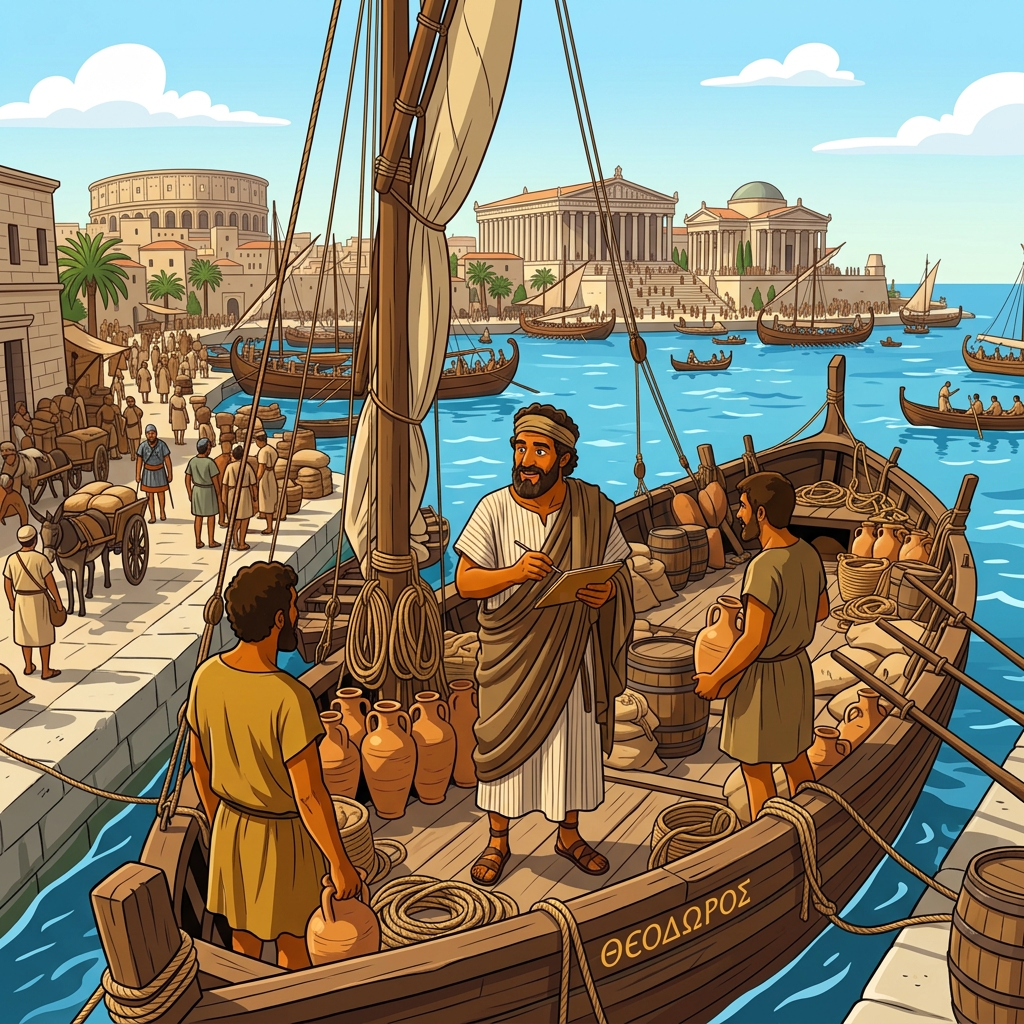
Familiarity feels so comforting. Even when the familiar isn’t objectively safe.
By the time Dexias reached Alexandria, he had shaken three men who had followed him from the Levant.
He had lost them somewhere beyond the salt flats: first by joining a grain caravan, then by hiding in a village of fishers. By the time the city rose before him in white stone and blue haze, he was reasonably certain they had given up.
Reasonably certain was the closest the roads ever allowed a man to come to safety.
Alexandria smelled of brine, hot papyrus, fish guts, and the sharp mineral tang of ink. Dexias knew its streets well. He had travelled from Indis to Alexandria more times than he could count.
Familiarity was comforting. But it was not the same as safety.
He had learned to sleep with one hand near his knife, dress poorer than he was, vary his routes, and keep his cargoes vague. A trader survived by revealing as little as possible. Information was protection. It was also leverage.
Dexias came and went for wine, silk, pepper, and precious stones. But recently, his travels had included a stop at Theron’s house, where a small bronze astrolabe sat waiting.
Dexias had seen it on his first visit, resting on a plain wooden stand beside the window. Babylonian in make, very well kept. It looked new. He had handled a few astrolabes in his time, but none had seemed so complete or so well designed. It could serve both as a navigation instrument and a decorative piece. It would fetch a high price with the right buyer.
He had wanted it ever since.
He had offered gold. He had offered pearls. He had even offered linen that had once belonged, or so the seller had sworn, to a Ptolemaic royal. On his last visit, he had offered enough Malabar pepper to make a lesser man’s eyes glisten and mouth water.
Theron had refused every time, not with anger but with a mild, faintly amused look.
He owned little and wanted less. His house held no silver, no ivory, and no carved chests of the kind Dexias filled his ships with. It held scrolls stacked to the ceiling, bread, wine, and the astrolabe.
His needs, he had once told Dexias, were food, three scrolls a week, and a steady supply of arguments worth having.
“You’re a merchant, Dexias. You should know to offer me things I actually value,” he said now, turning the astrolabe once in his hands before setting it back on its stand. “Gold and spices aren’t what I crave. What I never tire of, Dexias, is a new reason to think.”
Dexias glanced at the astrolabe.
“A puzzle to wrap your mind around?”
Theron smiled.
“Precisely.”
Dexias smiled too. This seemed an easy challenge.
“I will give you riddles. If I can make you think, the astrolabe is mine.”
Theron laughed and agreed.
Dexias felt confident. He had travelled far and wide and picked up many a tale in caravans and temple courtyards.
He began with the Sphinx’s riddle, the one every child on the Nile learned before learning to swim.
“What walks on four legs in the morning, two at noon, and three in the evening?”
Theron answered in a heartbeat.
“Man. He crawls on all fours at the dawn of his life, walks on two as an adult, and uses a cane in his latter days, three legs of sorts.”
Dexias paused. He had underestimated his opponent. But he pressed on, confident still.
“What has roots nobody sees and grows taller than trees?”
“A mountain.”
Again, Theron answered almost before he had finished.
Dexias wasn’t done yet. He paused, a mischievous smile forming.
“My mother I bring forth, and she brings forth me. I am sometimes greater and sometimes less than she.”
“Night and day,” Theron answered, barely looking up from the scroll he was considering. “Each gives birth to the other in endless succession, and their relative lengths shift with the seasons.”
Dexias was stumped. How had Theron solved this one so quickly? It was his best riddle.
Sensing his confusion, Theron explained.
“For forty years I have collected riddles, sayings, and observations from merchants, sailors, and pilgrims. You cannot make me think with something I’ve already pondered and solved.”
Then, setting down the scroll, he concluded:
“If you want the astrolabe, you must bring me something new. The best way is to make new riddles. And to do that, Dexias, you must learn to ask new questions.”
Dexias did not know, at first, what a new question looked like.
That became the subject of their subsequent conversations. He asked why the ants near the docks bit harder than the ants at home. He asked why wine improved with age. Theron answered each question briefly, then looked at him with an expression that made Dexias feel like a boy failing an examination, a man who had crossed a continent a few times and still couldn’t surprise someone who had rarely left his own neighbourhood.
Then one evening, while watching the light fade over the harbour, Dexias mentioned how both the moon and the sun were visible. They hung in the sky at once, as if neither had waited its turn.
Theron went still.
“That,” he said, “is a good observation.”
He turned it over in his mind for a moment, then repeated it back in a new form, tightened into something with edges.
“Two lamps are lit, and no one asks why, though custom says one suffices to light the whole hall. What are these two lamps?”
He looked at Dexias.
“There. That is a riddle. Now find one of your own.”
Dexias carried the instruction with him back onto the roads, but for a long while he made no progress. He watched caravans and camels, tradesmen and clients, landscape after landscape. None of it inspired anything.
Then, at a tavern outside Damascus, he fell in with a scribe named Iddin, hired to read letters aloud to travellers who couldn’t.
Dexias watched him work through the evening: a soldier’s letter to his mother, a merchant’s contract dispute, a girl’s letter to her betrothed.
Iddin read each one as if it were the only one that mattered. When a boy asked shyly if he might be taught to form the letters of his own name, Iddin spent the better part of an hour on him for a single coin, making shapes into the dust with a stick and correcting the boy’s grip without a trace of impatience.
“Three years you’ve been doing this?” Dexias asked afterward, watching the boy trace his name for the umpteenth time, badly but proudly.
“Four, now.” Iddin didn’t look up. “He’ll have it by autumn. Maybe a season longer.”
“And you’ll still be here?”
“I expect so.” He finally glanced at Dexias, faintly amused, the way Theron sometimes was. “You say that like it should have worn me down by now.”
Dexias had no answer.
A few days later, on the road again, a younger trader caught up with his caravan. He was new to the eastern routes, eager and half-lost.
He asked Dexias which wells between there and Palmyra could be trusted, and which merchants at the Palmyra market dealt fairly.
Dexias felt the old reflex before he could examine it: say less.
It was the instinct that had kept him alive when strangers followed him across the desert. It was also the instinct that made a trader protect his routes, his contacts, and every useful advantage from his competitors.
An answer formed, true enough but deliberately incomplete.
For reasons he couldn’t understand, Dexias did not give it.
“The well past the third dune never runs dry,” he said. “And don’t buy from the merchant at the Oasis. He is particularly wily.”
The young trader thanked him twice.
Dexias rode on, turning over the strange lightness in his chest. He could not decide whether he had lost something or set something down.
He thought of Iddin’s stick moving through the dust. He thought of the boy’s crooked letters, and of the young trader riding away with knowledge Dexias could easily have kept.
He turned the thought over in his head, trying to copy the way Theron had turned the moon and the sun.
By the time he reached Alexandria, he had a rough shape of a riddle, though he wasn’t satisfied with it.
He walked the last stretch to Theron’s house, still turning the words over and over, until he stood in the doorway.
“So,” Theron said. “What have you got for me?”
Dexias hesitated. Every riddle he had brought before this one had been borrowed, worn smooth by other mouths before his. This was the first that was only his, pulled from a scribe’s patience and a well he had decided not to keep to himself.
If Theron waved this one off too, Dexias wasn’t sure he had nothing else to offer.
“One riddle,” he said. “But it took me the whole voyage to find it.”
“If it’s marinated that long, I’m eager to hear it.”
Dexias took a deep breath.
“What is it,” he asked, “that a man may give away without losing any, and that grows greater in every mind it enters?”
Theron was silent for a while. Dexias was pleased.
“Knowledge,” Theron eventually said.
Dexias felt both proud of his riddle and disappointed that Theron had still solved it quickly.
Theron crossed the room and lifted the astrolabe from its stand.
“You have made me think,” he said. “It is yours.”
Dexias closed his fingers around the bronze.
The astrolabe was his at last. He had wanted it for months for its beauty, its usefulness, and its price.
But as he looked at Theron, he understood that the prize he valued now was something else entirely: the satisfaction of surprising the old man.
He had not quite managed that.
For the first time, he had taken the familiar and made something of his own from it. He had discovered a new kind of treasure, and he decided he would start trading in it too.
If something in this story sat with you, there’s more where this came from. Similar moments and questions show up across three collections. Each one goes a little deeper.
Vol 1 — seasons, angels, and the art of living
Vol 2 — nature, history, and what echoes
Vol 3 — the mind, the mirror, and what we imagine
Leave a Reply