

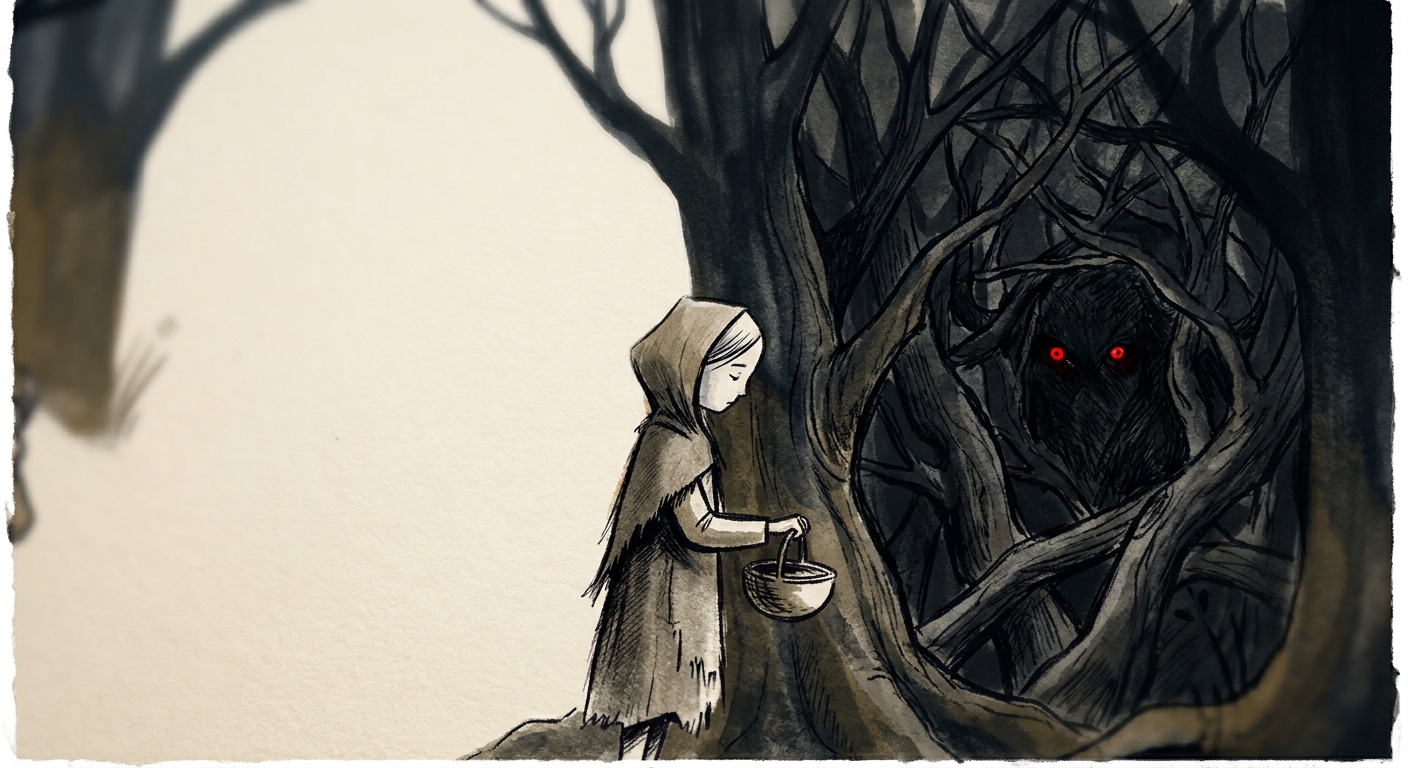
This village was notoriously inhabited by the fearless. Everybody around knew it. How could you not know? Their bravery had gone to their heads. Every interaction with one of them would have left a mark.
Even if you never met one, chances are you would have heard the noise of their regular “Nights of Courage.” Every new moon, they gathered to brag about their exploits, laugh loudly, and tell stories of how they had stood up to the beast that prowled in the woods.
The beast, they said, could smell fear. It would attack whoever was afraid and devour them. But it rarely came near the village. Everybody knew it was because the inhabitants of that particular village smelled of unadulterated bravery.
The girl who worked in the chief’s house wasn’t so sure.
She noticed knees knocking beneath tables, doors being locked as soon as the sun went down, and people glancing toward the forest whenever a dog barked. However, at each Night of Courage, everyone spoke of being fearless, acting brave, being loud.
The girl wasn’t dishonest about her fear. But she was probably as curious as she was afraid, if not more.
One morning, she found tracks of the beast near a chicken coop. They crossed the damp earth and disappeared among the trees. A few feathers lay beside them.
“The beast struck again,” one villager said. “It must have smelled the chickens’ fear.”
The girl studied the prints. They followed a particular path, winding around the village. The beast only came near under the cover of darkness. It hid deep within the woods. Few had ever seen it. Stories went around that it was a minotaur, that it had foul breath and beady red eyes.
The girl followed the tracks, her heart beating. This was not a good idea. She reeked of fear, she thought. The first day, she barely made it past the first trees. The second day, she made it past the second. She called herself a coward. The others were at home, behind locked doors, being fearless.
On the fifth day, she saw it from behind, crouched at the river, drinking. It looked imposing, dark, menacing. The birds, who had not been told of its reputation, carried on as usual. A butterfly landed on its shoulder.
The next morning, she returned with some food scraps.
She placed them among the oak’s roots, near the place where she had seen the beast the day before, and left.
The next day, the food was gone.
She came back the day after that, and the day after that. Then, one morning, she left the scraps and climbed up a tree nearby. Her heart beat so loudly she thought the beast might hear it. She sincerely hoped the food’s smell would overpower her own scent.
Then a shape emerged from the shadows.
The beast was smaller than she had thought, but its body was strange and misshapen, and one of its legs seemed deformed. It did not look like a mystical beast standing on its hind legs. It looked like a young buffalo. It moved cautiously, nose close to the ground. It ate the scraps, licked its snout, followed a trail of scent, and spotted the girl.
The beast gave a rough, low growl. The girl wanted to run. She froze. They stared at each other for what felt like an eternity. Then the beast turned away and disappeared among the trees.
The girl returned the next day. She left scraps in the same place.
They stared at each other again. This became a routine, and before long, the beast stopped growling, having apparently concluded that the growling was wasted on someone who kept bringing food.
The first time she held out her hand, it sniffed her fingers with the air of a customer who suspects the menu is lying, and declined. The girl felt its warm breath against her skin.
A few days later, she held out her hand again. This time, the beast took the food gently. Then it backed away and ate behind a tree.
One time, the beast came toward her before she had even put the food down. It had learned to recognize her steps, her smell, the sound of her approach. The girl hadn’t become its master, but she had become someone it didn’t need to fear.
One morning, as the girl crossed the edge of the woods with a basket, the beast emerged from the trees and came to meet her.
Some villagers saw.
One of them shouted, because that’s what they always did. Others came running. The beast growled, frightened by the noise, but it didn’t flee. It stayed beside the girl, comforted by the smell it knew.
The villagers stepped back.
“She’s tamed it!” someone cried.
“She isn’t afraid of the beast!” said another.
The girl tried to explain, but the villagers were already talking louder than she could and making up their version of events.
By the next Night of Courage, the story had improved considerably. There was now a struggle. By the third telling, they attributed extraordinary powers to the girl. She had faced the monster and subdued it with her smarts and bravery, and the chief declared her the bravest in the village, an honor that came with a seat nearer the fire and a great deal of staring.
The girl let them tell their story. Correcting them would have meant explaining, and explaining would have required the village to listen, which it had never been good at.
She knew the beast hadn’t been defeated. It had only stopped running away.
And she knew she had been afraid, almost the whole time.
Perhaps courage, she thought, wasn’t about never trembling. Perhaps it was staying long enough to understand that everything trembles, the beast, the girl, even a village full of the fearless, whether it shows or not.
Leave a Reply