

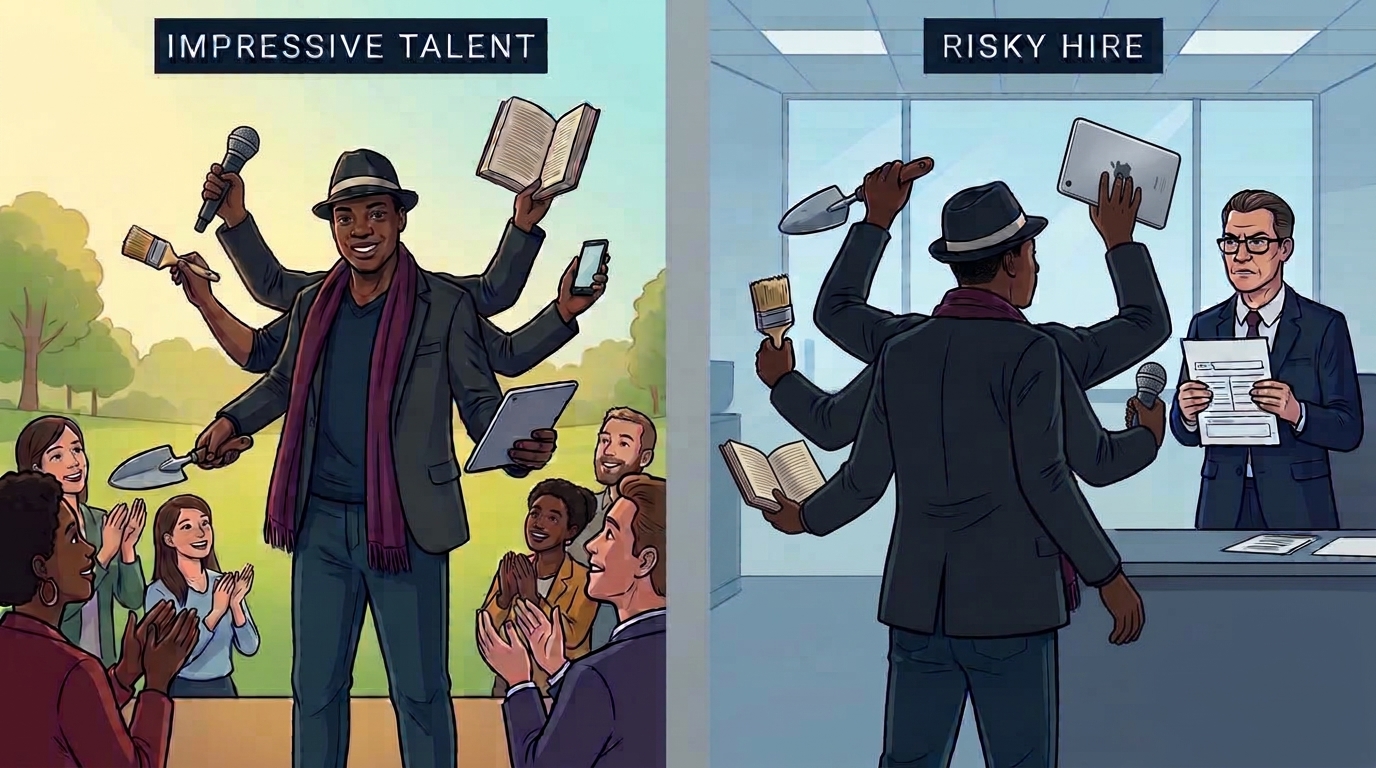
Last year, I asked if you’d join me in pursuing the Renaissance ideal. Here’s the bit I skipped: polymathy doesn’t always go down well on a CV.
It’s interesting how the same situation can be interpreted wildly differently depending on who’s looking at it.
Case in point: knowing the things I am able to do, people have often exclaimed, “You can do everything!” Far from it, of course, but I can see how it might look that way: I write, I sing, I dabble with a few instruments and a few languages. Blah blah blah. Okay, Rudiano, stop flexing!
Put that same set of facts in front of someone else, though, and you might get a frown, followed by: “You’re all over the place,” or, more diplomatically, “We’re not sure you’ll stay.”
Yes, you guessed it: in front of an employer, having done many things can work against you. Remember the pick-a-lane philosophy? It doesn’t stop when school does. It follows you into the workplace, right into the interview room.
Breadth can be taken to mean you’re not competent (hence the expression “Jack of all trades, master of none“), maybe hard to manage, not a team player, [Insert any other preconceived negative idea here].
I’m not dismissing those as possible explanations for someone’s varied work history. But it’s striking how the same set of experiences can be read as either admirable or suspicious.
It’s all about the observer’s perspective and what the situation asks of them. An employer needs to assess whether you can do the job, whether they can afford you, manage you, and whether you’ll stay. But those questions sometimes bring a narrow lens and assumptions, one of them being that breadth means you are a bit of a risk.
The thing is to work on that perspective. It’s very easy to internalise the general assumptions, and that’s where we would be wrong and shoot ourselves in the foot. We need to communicate a different perspective.
Maybe we did have a varied work history, but we can connect the dots that the employer doesn’t see. We don’t always control the circumstances. Layoffs happen. Markets pivot. Priorities shift. We bounced back and adapted to new challenges, and that shows resilience, agility and drive. Diverse experience doesn’t necessarily mean jumping ship at the first opportunity; it means being ready for real progression in a role with scope to grow.
But here’s something else. These days, with the pace of change, I’d argue that if we have breadth, it’s our time to shine. I said before that the future belongs to those who can connect the dots, even though the world doesn’t seem to have caught up yet. The ones who connect the dots should stop hiding. The modernised adage does says “Jack of all trades, master of none but oftentimes better than a master of one”.
The factory-inspired way of dividing labour (one person, one task, one lane) is very shaky, I feel, in a world where problems don’t respect lanes. We are going to have to rethink many of our antiquated ways.
So where do we start? Off the top of my head, here’s what’s on my list.
Education. We still ask young people to pick a lane before they’re ready, and the lanes they are supposedly training for may well disappear by the time they enter the workforce. Education needs a revamp, and not just in what we teach, but in what it’s for.
Thinking itself. When every answer arrives instantly and effortlessly, who does the work of thinking? Young minds still need to learn how, and why it’s worth the effort when a machine will happily do it for them.
Judgment, taste, creativity. AI can imitate all three quite convincingly. We need to keep the real thing alive, and be able to tell the difference. Otherwise, we risk swapping our humanity for an imitation of it, and losing a lot of our joy and fulfilment along the way. I fear a deeper depression is coming. Remember how connected we are with technology now, and yet how disconnected we feel? Same pattern. AI could put it on steroids.
Critical thinking. Hallucinations now come well articulated. Fluent is not the same as true, and a smooth paragraph is no longer evidence of anything. Imagine a world where barefaced, disastrous lies pass for truth and we fall for them daily. We’re not far off: deepfakes and professionally voiced, well articulated scams are already around.
The ground has shifted under all of us. We have to find our footing first, then help the younger ones find theirs.
Tall order, I know. And I don’t think any single discipline can fill it. It will take educators, psychologists, technologists, writers, artists, all in the same room. In other words: interdisciplinary. Polymathy again.
Which brings me back to the frown in the interview room. The people who were told “you’re all over the place” might be exactly the ones this moment needs.
Are you one of them? And more importantly, how can we contribute to address this conundrum?
Reflect, Redefine, Rise!
R.
Leave a Reply