

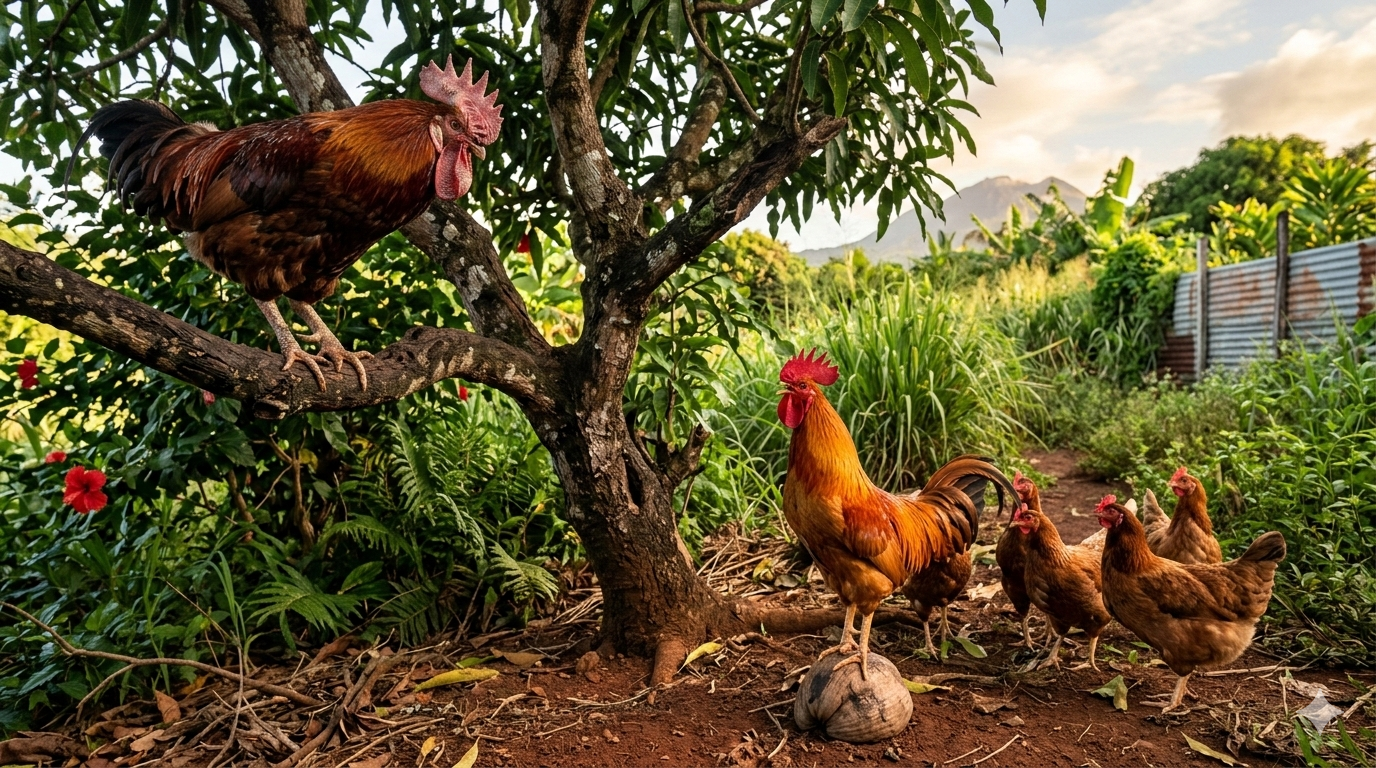
The yard belonged to Reginald. Under the Mango tree, he was the sun around which all life orbited.
His harem moved in a synchronised dance of scratching and pecking, always within the shadow of his mahogany wings. He was the “Main Man,” the undisputed law round these parts.
His crow was the authority: a weathered bass that shook the dew from the hibiscus leaves. It was the sound of a settled empire.
But one sweltering Tuesday, in the drowsy heat of midday when even the iguanas stayed still, the silence was shattered.
Err-er-err-ERHH!
It was thin; it was squeaky. It cracked at the end like a dry twig.
Reginald did not even stand up. He just tilted his scarred head, his battle-worn comb flopping slightly to the side. He let out a low, guttural chuckle that rippled through his chest.
“Listen to that,” he muttered to a senior hen. “Stevie thinks he can crow but he sounds like a rusty hinge on a garden gate.”
He watched the young cockerel, Stevie, standing on a discarded coconut shell. Stevie looked embarrassed, his chest puffed out but his legs a little wobbly. Reginald felt a surge of patronising pride. It was cute; it was non-threatening. It was a “whipper-snapper” playing at being a king, a mere court jester.
But the tropics have a way of ripening things fast.
As the rains came and went, Stevie began to change. The squeaky crack disappeared. The “noise” began to find a rhythm. Day by day, the pitch dropped, vibrating with a resonance that Reginald had not expected. It was not just a noise anymore; it was a crow in its purest, most soulful form.
Reginald stopped laughing.
He noticed the hens would pause whenever Stevie practised by the hibiscus hedge. Even when he was just trotting around , they looked at his vibrant plumage and youthful beauty. Their murmurs began to reach his ears: “He is coming into his own, that one,” they whispered.
Reginald grew more and more annoyed. The admiration in the yard was a direct threat.
His tolerance turned into a cold, calculated campaign of suppression.
“You are out of line,” Reginald would hiss, chasing the younger bird each time he dared to open his beak. “You are just a pretty boy with a loud throat. You haven’t earned your spurs. Stay in your lane, or I will make sure you have no lane left.”
Reginald fooled himself into thinking he was “toughening his boy up.”
Then, one morning, the silence returned.
No melodious crow from the hibiscus hedge. Reginald strutted through the yard, puffing his chest, certain that his bullying had finally broken the young bird’s spirit and put him back in his place. He felt a smug, hollow victory.
But that wasn’t the reality. Stevie was gone.
It was a senior hen who finally broke the news. As she pecked at a fallen mango, she didn’t even look up at him. “You should be proud. Your boy has gone to the tall grass beyond the fence,” she said casually. “He has a crew of his own now. They say his harem is larger than yours. They say they follow him just to hear him sing at dawn.”
Reginald stood frozen. A wave of bitter spite washed over him, hot and sharp. He had spent so much energy trying to dim another’s light to protect his own.
He was still the king of his dominion but his kingdom felt smaller than ever before.
Reginald was a great protector but not a great leader. Because true leadership is a torch to be passed, not a flame to be hoarded.
If you liked this story, there’s a whole world where donkeys race, kitties pull strings, and goats gallivant. If you want more of that world, it’s waiting.
Vol 1 — where it all began
Vol 2 — wilder, weirder, deeper
Vol 3 — the one that breaks your brain (kindly)
Leave a Reply