

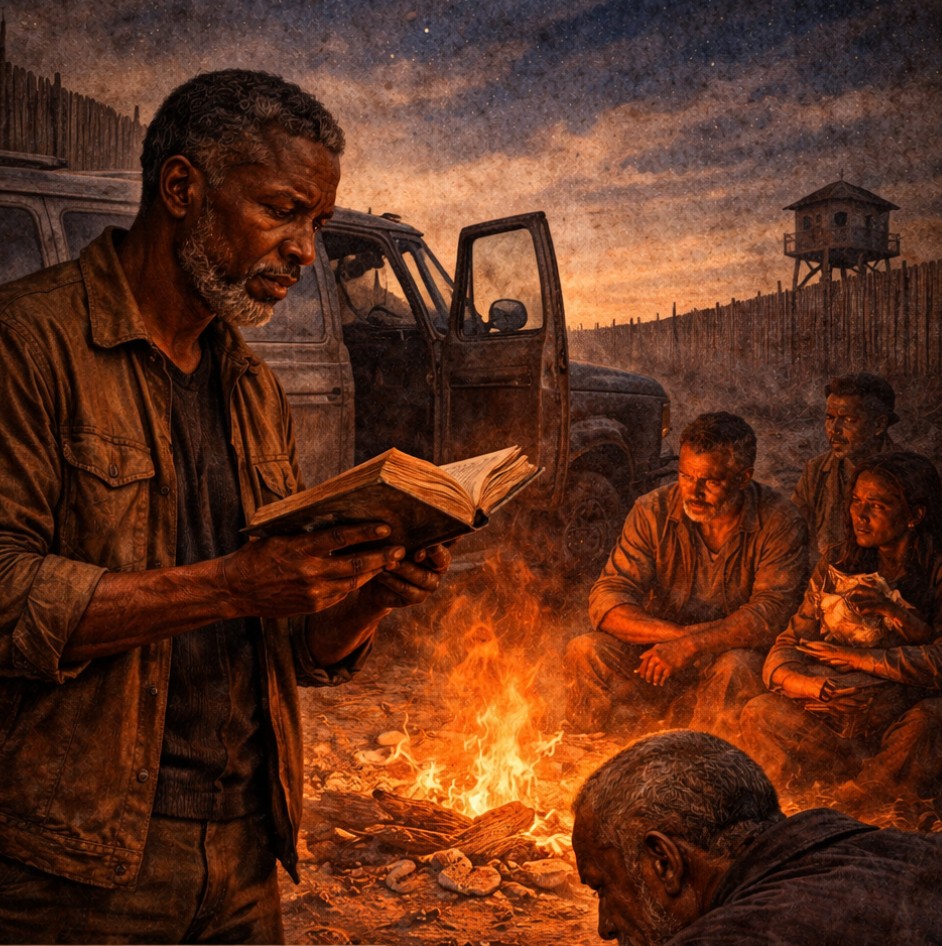
The van had come with the book.
Cael had inherited both from his uncle, who had inherited the van from someone else and never mentioned the book at all. Either because he hadn’t noticed it, or because he had and thought it better not to. It lived in a metal box bolted under the passenger seat, wrapped in oilcloth so old the cloth had become part of it, the way skin becomes part of a scar.
He found it three weeks into his first run, when the van hit a rut. The box sprang open, slid out across the floor and came to rest against his boot, as though it had been waiting for a moment to get noticed.
He didn’t open it for another week after that.
The roads between settlements were not roads in any old world sense. They were suggestions: packed dirt where enough vehicles had agreed to go in the same general direction, threading through land that had stopped pretending to be organised. The sky above was wide and bright, not an inviting blue but a hard, blinding colour that matched the desert landscape below it.
Cael drove with the window down. The aircon had long since packed up, and fixing it would have meant sourcing gas or an obscure part he didn’t have time to track down.
He carried trade goods. Salt, dried medicine, spare parts stripped from vehicles that had given up on the side of the road. He ran a loose circuit between settlements, shaped by what he had and who needed it. The people in those places knew the sound of his engine the way earlier generations had known the sound of an ice cream van.
He was not a warm man. He was not unfriendly, either. He was the kind of man the road makes: practical, careful with words, attentive to the particular silence that precedes trouble. His face had been weathered into something approaching neutrality, and his eyes had seen enough to stop being surprised by most things.
The book surprised him when he began reading it. He was curious at first, puzzled at times, but kept coming back to it.
One evening, he read it aloud.
It was in a settlement called Dross. Twelve families behind a wall of corrugated iron, governed by a woman named Petch who had the handshake of someone who had once broken a man’s wrist to make a point and wanted you to know it. Cael had finished his trading and was sitting at their communal fire when someone asked if he carried any news.
He had no news. He had the book.
He didn’t know why he produced it, but he read the first thing his eye landed on. Something about a shepherd and a lost animal: the shepherd leaving everything to go and find the one that was missing, and when he found it, carrying it home on his shoulders.
He stopped reading. The fire crackled. Nobody spoke.
He looked up to find a dozen people looking at him. Not at the book, not at the fire, but at him, as though the words had come from somewhere inside him personally. An old man at the edge of the circle had his head slightly bowed. A young woman with a child in her lap had gone very still, her hand paused mid-stroke on the child’s hair.
“What is that?” Petch asked. Her voice had shifted into something less guarded, a register that didn’t suit the image she maintained.
“I don’t entirely know,” Cael said, which was the truth.
“Read another.”
He read another.
He read about a man who was swallowed by the deep and survived it. He read about bread that fell from an empty sky to feed people who had nothing. He read a list of names, long and rhythmic, like a map of people who had existed and mattered and were being insisted upon in the face of the world’s tendency to forget. He read about a woman who followed someone she had no obligation to follow, into a country she had never seen, because she had decided that where they went, she would go, and where they died, she would die.
He read slowly, and his voice, usually flat and functional, took on something he couldn’t have named.
He could not explain any of it. He simply read, and the fire went low without anyone thinking to feed it, and nobody went to bed.
When he finally closed the book, the night was deep and the settlement very quiet.
“Where does it come from?” the old man asked.
“It was in the van,” Cael said. “Before me.”
“What does it mean?”
Cael wrapped the book back in its oilcloth. “I think,” he said slowly, “that it means different things in different parts of it. And maybe different things to different people.” He looked at the old man. “What did it mean to you?”
The old man was quiet for a long time. “It meant,” he said finally, “that someone was keeping count. Of people. Of what they did and who they were.” He looked into the dead fire. “I had not considered that anyone was keeping count.”
Cael stayed two nights in Dross, which was longer than his circuit allowed for.
On the second night, the young woman with the child found him at the van. Her name was Sable. She had a directness about her that had clearly been arrived at through difficulty: the kind of straight gaze that isn’t born but made.
“The part about the shepherd,” she said, without preamble. “The one who leaves everything for the one that’s lost.”
“Yes.”
“That’s not how it works out here. You lose one, you protect the rest. You don’t go back.”
“No,” Cael agreed. “You don’t.”
“So why does it say that?”
Cael leaned against the van and looked at the sky, which was doing nothing in particular. “I think it’s describing something that doesn’t follow the logic of out here. Something that works by a different arithmetic entirely.”
Sable was quiet. Her child was asleep in the shelter behind her, and she had the particular stillness of a mother listening for sounds through walls.
“My brother went out three years ago and didn’t come back,” she said. Not like a confession. Like a fact she was finally setting down somewhere outside herself.
Cael said nothing, because there was nothing that would have helped and he knew better than to offer things that didn’t help.
“I’ve been angry at the story ever since you read it,” she said. “About the shepherd.”
“I know,” he said.
“You can’t know that.”
“No,” he said. “But I recognised the expression.”
She looked at him for a moment, then looked away, and the anger in her face became something else. Not softer exactly, but more honestly shaped, the way a wound looks after the swelling goes down.
“Does it say anything else?” she asked. “About the ones who don’t come back?”
Cael thought about this carefully.
“It says that being lost is not the same as being forgotten. And that grief is not the same as the end of the story.”
Sable stood there for a long time after that, not speaking, looking at the dark shape of the settlement wall against the darker sky. When she finally went back inside, she didn’t say thank you, and Cael didn’t expect her to. Some things aren’t transactions.
He left Dross the next morning before the settlement properly woke, the van’s engine turning over in the grey pre-dawn light with its usual tone of reluctant obligation. The book was back in its box beneath the seat, wrapped in its oilcloth, quiet and dense with whatever it was.
He had still not reached the end of it. He wasn’t sure he was meant to reach the end of it quickly. It seemed like the kind of thing that gave differently depending on where you were when you came to it: which road, which weather, which particular weight you happened to be carrying that day.
He drove west into a sky the colour of old iron.
Three days out, he stopped at a settlement he had never visited before. A cluster of low buildings behind an earthen berm, smoke rising from two of them, a child watching him from the top of the wall. He traded his salt and his spare parts and his dried medicine. He ate their food and was grateful for it.
And when someone asked, as someone always did, whether he had any news, he reached beneath the seat and produced the book, and he read.
He read Psalm 23. All of it, slowly.
The Lord is my shepherd; I shall not want. He makes me lie down in green pastures. He leads me beside still waters. He restores my soul.
He paused there. Green pastures. Still waters. He looked at the faces around the fire, at the cracked land beyond the wall, at people who had spent their lives calculating exactly how much water was left.
He kept reading.
Even though I walk through the valley of the shadow of death, I will fear no evil, for you are with me.
His voice stayed level. He had learned to keep it level.
But this was the line he came back to.
Every time, on every road. Not as a comfort exactly, not at first, but as a recognition. Because that was what the roads were. That was the honest name for them. He had driven through the kind of dark where the silence had a quality to it that meant something was moving in it. He had talked his way out of situations that could have ended him, and driven away from others with his hands still unsteady on the wheel. He had seen what men did to each other in the unmapped stretches where no one was keeping count of anything. Every trip out was a passage through something that had no better description than the one the psalm gave it.
“The valley of the shadow of death”. He had not chosen the road expecting otherwise. But he had not expected, either, to find a name for it waiting in a box beneath the seat.
I will fear no evil, for you are with me.
He had turned that over more times than he could count, on long empty stretches, in the particular thinking-space that only a featureless landscape provides. He was not a man given to conclusions he couldn’t demonstrate. But the close calls had been close, and he was still here, and at some point the arithmetic of that had begun to suggest something. Not loudly. Not in a way he could have argued in front of anyone. But quietly, the way a man arrives at a thing he has known for a while without quite admitting it: that he had not been making those passages entirely alone.
He looked up at the faces around the fire. They had gone still in the way he had come to recognise. The way people go still not when they are empty, but when something is being filled.
And he noticed, if he was being honest, that something in him went still too.
That seemed to him like a kind of answer.
Not the whole answer. But enough to keep driving.
Leave a Reply