

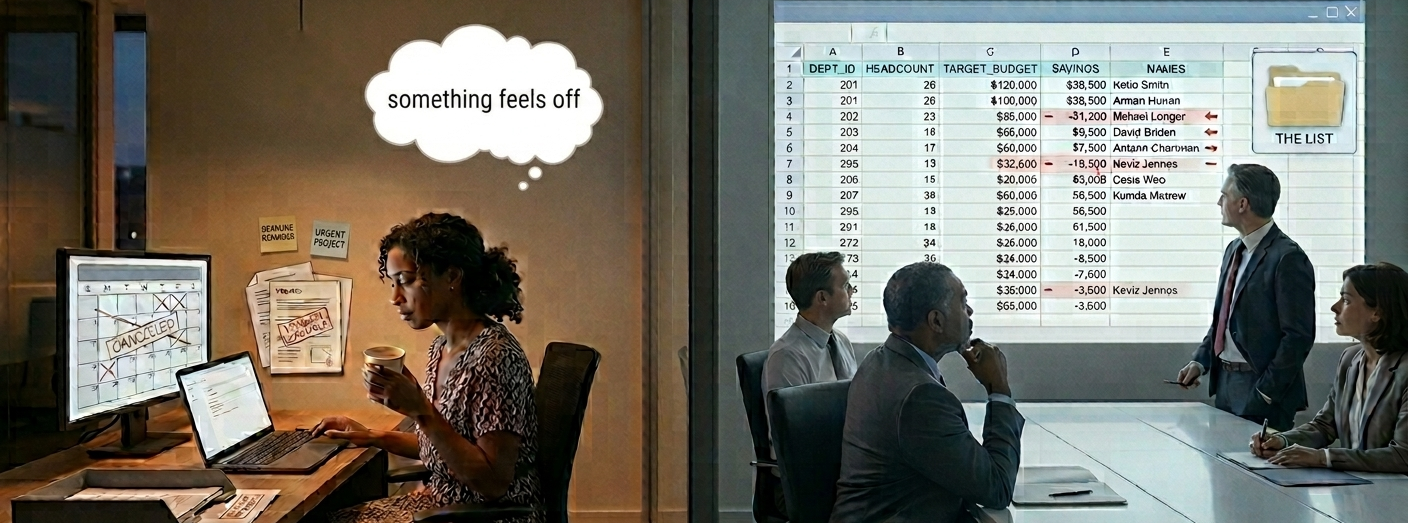
A few months before the role disappears, there usually are signs. A routine meeting gets cancelled for no reason. A project we’re on gets quietly handed sideways. An email thread we used to be copied on no longer includes us.
We explain the signs away on the company’s behalf. Something urgent. Busy quarter. Last-minute change. Nothing to do with us specifically.
We were half right. It had nothing to do with us specifically. The part we got wrong is what it meant.
Here is the piece of information we didn’t have access to: somewhere above us, on a date we will never be told, a list existed, with actual names on it, being reviewed by people we may have never met, weighing factors we were never shown. The map of that process was never going to reach us. It wasn’t designed to.
We assume, because nothing else is offered to us, that whatever produced that list must have been rigorous. Fair, even, because this is people’s lives we’re talking about here. We assume this because the alternative, that the process can be rough, even rushed, shaped by who happened to be visible to whom in that particular quarter, is harder to sit with.
So when our name turned out to be on that list, we treated it as an objective measurement of us specifically. The reality is that the list was built by people optimising for a number that often had very little to do with whether we were good at the job.
A name on the list might have been about cost, or politics, or a manager protecting someone they liked more, or genuinely nothing personal at all. Just a name, picked from a spreadsheet.
Explaining the criteria would require defending them. Defending them would require admitting the process was perhaps not as clean as “the role became redundant” makes it sound. That’s a harder conversation than the institution has any incentive to start. So the silence holds, by default rather than by design, and we’re left to fill the gap with whatever story is easiest to reach for. Which is almost always a story about our own inadequacy, because that’s the story we have the most practice writing.
Meanwhile, somewhere else in the building, the list has already been archived. The decision absorbed into next quarter’s plan. Nobody on that side is doing the emotional work we’re doing on this side, because for them it was just a number. For us it was much more.
We are the only ones still treating the event like a story with a real character in it. The company was working from a spreadsheet. We were the only ones in the room who thought we were both reading the same book.
The weight of that gap, between what we thought was being measured and what was actually being measured, lands entirely on us. As confusion first. Then as a story about what we’re worth. Then as the thing we carry into the next interview, the next role, the next time someone asks us to walk them though our career.
This post isn’t to make you suspicious of every quiet meeting or every email thread that goes silent. Most of those moments really are nothing. But when the list does eventually have your name on it, and at some point for almost everyone it will, know that there was a process, with its own weird logic, that you were never going to be shown.
Stop trying to reconstruct a fair trial out of a spreadsheet. Stop hunting your own conduct for the clue that explains it. Ask a smaller, more useful question instead: not what was wrong with me, but what was this redundancy actually optimising for, and was I ever going to be safe no matter what I did.
For most of us, the honest answer to the last question is no. And that answer is the beginning of carrying the right weight, and putting down the wrong one.
Reflect, redefine, rise!
Rudiano
Leave a Reply