

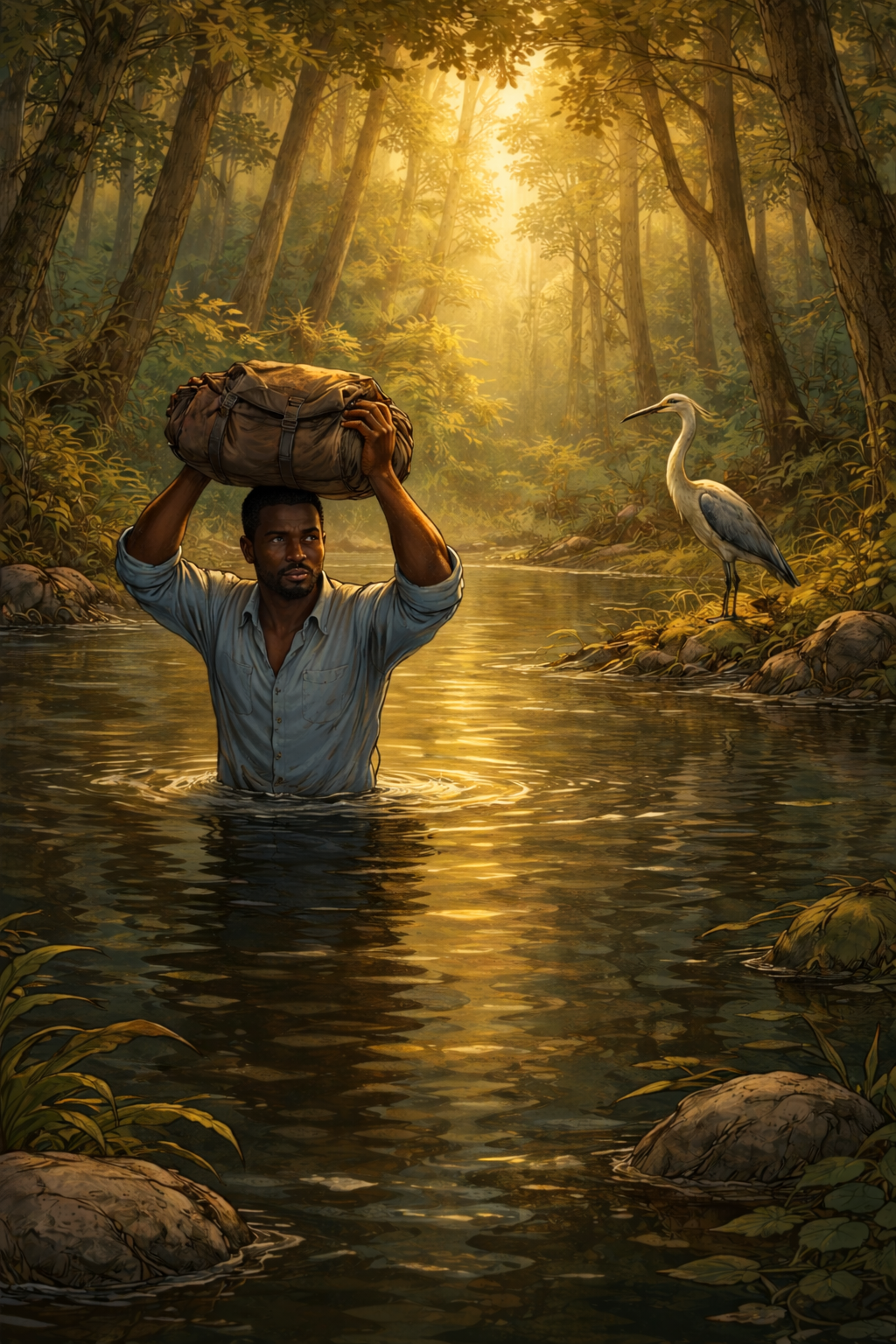
The old river road began sensibly enough. It was a modest dirt track lined with elderflower and the occasional flock of chickens, and for the first hour Gerdy felt quite confident he was the sort of man who went on journeys.
He had his provisions. He had his map. He had a small piece of frosted sea glass in his pocket, which he touched occasionally for no reason he could name.
Then the road bent. Not gently like the way roads do when navigating a hill or respecting someone’s fence. It doubled back on itself like a sentence that had forgotten its point.
Gerdy consulted the map. It offered only its simple ink trees and the unhelpful instruction he had already memorised: when the path refuses to stay straight, keep going.
So he kept going.
By midday, the pale elderflower had faded into a denser, darker wood. Long columns of light slanted through the canopy, as if the sun were searching for a secret etched into the forest floor. The air grew heavy with the scent of pine resin. Gradually, the distant lowing of farm animals died away, replaced by the steady hum of insects and the sharp trill of wild birds in the heat.
Gerdy noticed that his shadow kept appearing on a different side of him, which he chose not to dwell upon.
He came first to a wide, still pond. At its edge sat a heron, motionless and improbably tall, studying the water with the focused gravity of a philosopher contemplating a particularly thorny problem. Gerdy slowed. The heron did not look up.
“Hello,” Gerdy said, because he was that sort of man. The heron turned one amber eye toward him.
“You’re going to the grove.”
“I am.”
“Then you’ll want to cross.”
It tilted its long beak at the water. “There’s no way around.”
Gerdy looked at the pond. It was opaque and dark, the surface smooth as a held breath.
“How deep is it?”
“Deep enough,” the heron said, “to ruin everything you’re carrying if you’re not willing to hold it above your head.”
Gerdy didn’t question him. He simply lifted his burdens toward the sky and stepped in, shattering the mirror of the water.
The water was cold in the way that cold has a personality: bracing, almost rude, deeply unimpressed by his discomfort.
He shuffled forward, and the pond, true to the heron’s word, came up to his chest before it relented and began to shallow.
When he climbed out the other side, dripping and somewhat ridiculous, he turned to find the heron watching him with something that might have been approval, or might simply have been the natural expression of herons.
“Is the wise one in the grove?” Gerdy called back, wringing his sleeve.
“You already know,” the heron replied, and returned to its contemplation of the water.
Gerdy slogged onward. He supposed he did know. And if he didn’t, he was at least wise enough not to stand dripping on a riverbank, asking a bird to be more generous with its certainties.
The stone bridge, when he found it, was indeed broken. Not dramatically, not collapsed into the river in some grand gesture of ruin, but fractured quietly down the middle, a single clean crack, as though it had simply thought better of connecting one bank to the other.
Gerdy stepped across the gap with relative ease and felt, briefly, that the map might be overstating its obstacles.
Then the trees thickened, and the path dissolved entirely. This, he understood, was the part where the map’s instruction applied most honestly. There was no trail. There were only trees in every direction, patient and enormous, their roots knotted above the ground like the fingers of sleeping giants.
The light here was amber and diffuse, the colour of late afternoon preserved somehow beyond the reach of time.
He chose a direction by instinct until the trees parted. Then the giant sequoia came into view.
It was not what he expected, though he could not have said what he had expected. It leaned slightly over the clearing. Its bark was the deep red of old embers, as though the tree had been taking notes on centuries and storing them in its skin. Beside it, a great root had lifted from the earth to form a natural seat, worn smooth in the middle in a way that suggested long and frequent use. In that seat sat a figure.
She was old in the way that mountains are old, not frail, but settled. Her hair was white and loosely gathered, her clothes the colour of bark and lichen, and around her neck hung a collection of small objects on leather cord: a key, a button, a piece of amber with something frozen inside it.
She was whittling something from a pale piece of wood, and she did not look up as Gerdy approached.
“You’re wet,” she observed.
“There was a pond,” he said.
“There usually is.” She examined her whittling, turning it slowly.
“Sit down. You look like a man who’s been thinking so hard, you forgot how to do anything else.”
Gerdy perched on a nearby root. The clearing was hushed. It wasn’t the silence of an empty room, but the sharp, prickly silence of an audience waiting for the first word.
He reached into his pocket and turned the sea glass over in his fingers, for comfort.
“A merchant sent me,” he began.
“He said you could untangle the questions of my heart.”
“Merchants,” she said, without inflection. She blew a curl of wood shaving from her work.
“They can never keep a secret.”
She glanced at him sideways, and her eyes were the colour of river water over stone.
“What is your question?”
Gerdy opened his mouth, and the honesty of what came out surprised him.
“I make things that people think are useless,” he said, “and I’m not sure whether they’re wrong about that, or whether I am.”
The wise one set down her whittling and looked at him properly for the first time.
“What is that you are hiding in your pockets?”
He slowly pulled out the sea glass. It caught the amber sun and transformed into something cool and deep. It scattered ghosts of light across the roots and the bark. The Wise One watched them move in silence…
Then she spoke.
“I think I have just the thing for a man of your mind,” she said, leaning in. “I’m going to answer your question with one of my own.”
Gerdy squared his shoulders. “Go on then.”
She began. “A man wakes one morning to find a painting on his wall, vivid, enormous, unlike anything he has ever seen. He has no memory of putting it there. He studies it every day. It moves him in ways he cannot explain. It becomes the thing he measures all other beauty against.”
She paused, smoothing a fold in her sleeve.
“Years pass. One night, he finds a journal beneath a loose floorboard. His own handwriting. Page after page of sketches, the same painting, planned in meticulous detail, colour by colour, brushstroke by brushstroke. He painted it himself. He simply forgot.”
The clearing continued to hold its breath.
“Here is the puzzle,” she said. “Does the painting have less value now?”
Gerdy answered immediately, the way one does when one is confident and wrong. “In a way, yes,” he said. “The mystery was part of the painting’s power. Once he knows he made it, the awe collapses. He’s just a man looking at his own work.”
The wise one did not nod, but she did not correct him either. She simply picked up her whittling and resumed, slowly, as though she had all the time the sequoia had, which was considerable.
The silence stretched. Gerdy turned the sea glass over in his palm. The little lights still wandered across the bark, indifferent to his conclusion.
“But the man,” he said, the silence stretching between them, “he didn’t know the painting was his. That’s the point, isn’t it? He loved it only because he thought it was a stranger’s.”
“Yes,” she murmured.
“So the question isn’t about value.” He spoke slowly, weighing each syllable like a stone. “The question is why he could only love it when he thought it belonged to someone else.”
In the distance, the repeating call of a kingfisher drifted through the heat. The clearing seemed to lean in, a quiet witness to Gerdy’s musing.
He looked down at the sea glass. He had carried it the whole way. Held it above his head through the cold pond. Pressed it to his chest beneath the map. Found it on a beach once and felt something. Something without words, without justification.
“I’ve been waiting,” he said, his voice barely a ripple in the stillness, “to discover that someone else had already made what I was trying to make. I wanted to find it finished, so I could love the work without the shame of having been the one to fail at it.”
The figure in the Wise One’s hand was beginning to emerge from the wood: a traveler mid-stride, leaning into a wind only the carving could feel. She didn’t look up, but her knife slowed.
Gerdy closed his fingers around the sea glass. It was warm now, buzzing with the heat of his own palm. He had found it. He had carried it. He had held it high above the drowning dark of the pond and watched it throw light onto things that needed illuminating.
The glass didn’t care who had found it, and the light didn’t care who held the shard.
It was beautiful in its own right, regardless.
“You are a man who admires the stars,” the Wise One said, “but despises the hand that points to them because that hand is yours. Now go. On the road back, the path will stay straight. Not because the world has changed, but because you will stop trying to outrun your own shadow.”
To be continued…
If you missed it, find Part 1 here.
For part 3 click here
Leave a Reply