

Staple Green did not notice Gerdy return.
This was not surprising. The village was busy with itself: the sharp clang of hammers on iron, the sounds of livestock in the crowded market, the tireless calls of merchants haggling over salted fish, fruit, and other wares. The machine clattered on, each part performing its rehearsed role with grim efficiency, and Gerdy slipped back into it the way a stone slips into deep water: without ceremony, leaving only the faintest ring of disturbance before the water closed over and forgot it had ever been troubled at all.
His shack had collected salt and cobwebs in his absence, as expected. He swept it out without resentment. The spiders too had been industrious.
He did not unpack immediately. He sat for a while on the low bench by the window, watching the light move across the floor, and he thought about the man in the puzzle who had painted something true enough to move himself, then spent years pretending he hadn’t. He thought about the heron, standing at the edge of its pond with the patience of something that had a completely different concept of time. He thought about the Wise One’s small whittled figure, mid-stride, leaning into a wind only the carving could feel.
Then he unpacked, and he went to work.
What he made in the days that followed was not grand in the way that statues are grand, or bridges, or gestures that demand an audience. It was small and precise and entirely itself.
He sorted his fragments without apology now and selected the pieces that caught light most generously. He arranged them into a hanging, strung on fine wire salvaged from an old lantern frame, designed to turn slowly in a coastal wind. It was, by any practical measure, unnecessary. It was, by the measure he had finally remembered he was allowed to use, exactly right.
He worked by candlelight, and for once the candle did not feel like an accusation.
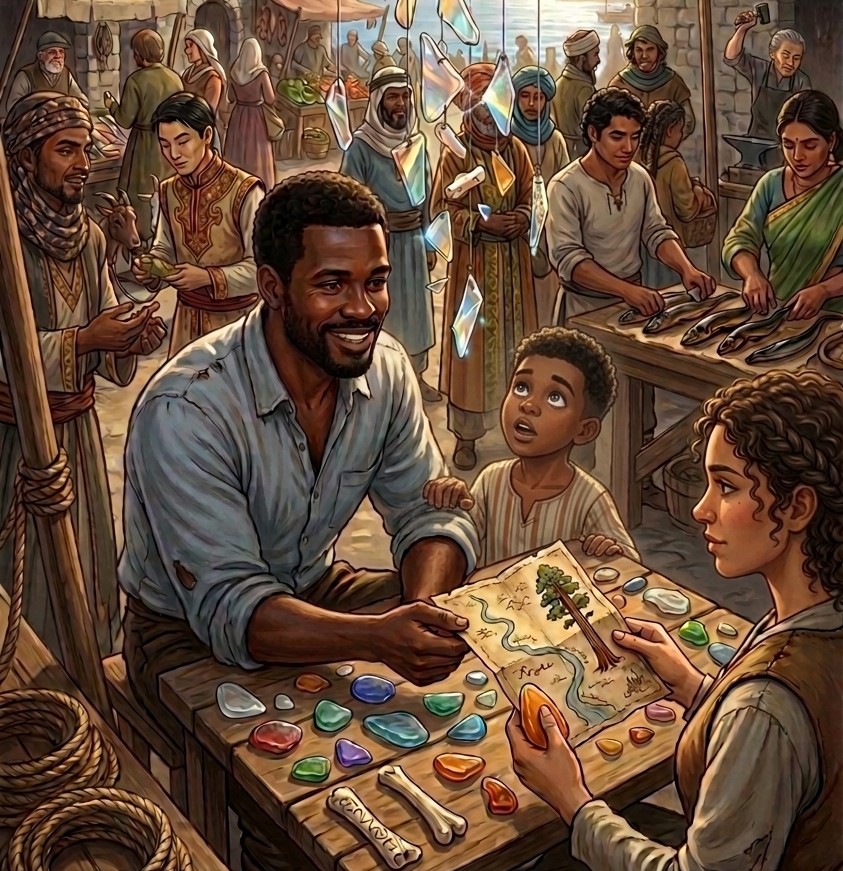
On the morning he carried his table back to the market, the village was in its usual clamour. He set up without announcement between the rope seller and the woman who dealt in smoked eel, and he laid out his wares the way he always had, the glass and bone catching the early light, throwing their small private fires across the way.
The hanging turned slowly above him in the sea wind. A child stopped beneath it, mouth open, tracking the moving brightness with the total absorption that children bring to things adults have learned to walk past. Gerdy watched and said nothing. Some transactions required no words.
The elders passed, as elders do.
“Still at it, then,” one said, not breaking stride.
“Still at it,” Gerdy agreed, pleasantly.
He was not performing indifference. He had simply stopped handing them the paintbrush.
The elder paused. Barely, just a half-step’s hesitation, then walked on. It was a small thing. But small things, Gerdy now understood, were often where the real shifts lived.
Late in the afternoon, a young woman stopped at his stall. Gerdy recognised the expression on her face. She had the look of someone who had been thinking very hard for a long time and was tired of doing it alone.
She picked up a piece of frosted glass and turned it slowly in her fingers. She had a calm, searching quality, hiding a turmoil inside.
“This catches the light in an extraordinary way,” she said, almost to herself.
Gerdy studied her; the careful way she held the glass, the slight furrow between her brows that had nothing to do with the price. “You stopped at the glass,” he said, “but you weren’t really looking at it.”
She glanced up. “I was looking at it.”
“You were looking through it,” he said, “at something else entirely.”
She opened her mouth, closed it, and then laughed once . A short, involuntary sound, the kind that escapes to hide embarrassment .
She looked at him with the wariness of someone who has just been found out and isn’t sure yet whether to be grateful or unsettled.
“I do that sometimes,” she said eventually. “Think too hard about things that don’t have clean answers.”
“So did I,” Gerdy said. “For longer than was useful.”
A beat passed between them.
He leaned forward slightly. “I once knew a man,” he began, his voice dropping to a quieter register, “who made things that his village had no use for. He had questions of the heart he couldn’t untangle on his own, questions about whether the work meant anything, about whether he meant anything. He carried those questions for years before someone showed him the way to find his answers.”
The young woman had gone very still. Her eyes dropped to the glass in her hand, then rose slowly back to his face.
“What did he find?” she asked.
Gerdy smiled cheekily.
“Knowing this won’t help you. But this will”
He reached beneath the table and produced the folded map : the simple ink trees, the one towering trunk, the blue lines that had led him through a cold pond, a cracked bridge, and a forest with no path until he walked one into it.
“I was told to pass this on,” he said, “to someone who needed it.” He tapped the paper, just as the merchant had once tapped it for him. “Follow the old river road until the stone bridge breaks. When the path refuses to stay straight, keep going. In a clearing where a great sequoia leans over the world, you’ll find the Wise One. She has a way of showing you what you already know but haven’t yet been brave enough to look at directly.”
She glanced at the map as though it might dissolve if she stared at it too long. Then she took it carefully, the way you take something that matters, and tucked it close.
She looked at the glass still in her other hand.
“How much?” she asked.
“Consider it a gift” Gerdy said.
She looked at him once more and then walked away into the clatter of the village, the map pressed against her ribs, the glass wrapped in her fist, already catching light she hadn’t noticed yet.
Gerdy watched her go, and felt the particular lightness of a mission completed.
That evening, he gathered his wares as the last of the sun dipped below the horizon. The glass glowed its deep, fiery orange, the same as it always had, the same as it had on the evening a merchant with ink beneath his sleeve had stopped at this very table and asked a question that refused to stay small.
The village clattered around him, hammers and livestock and the tireless commerce of useful things, and Gerdy moved through it at his own tempo, unhurried, the hanging cradled carefully so its lights did not tangle.
He was a man of fleeting ideas and quiet dreams. He was an explorer and a collector of things most would dismiss as rubbish. He was, the elders would still say, a dabbler and a drifter. The village had not changed its mind about him, and he had stopped waiting for it to.
That, he understood now, was not defeat. That was the bridge, cracked clean down the middle, the new world simply deciding it no longer needed to reach the old one.
He walked home along the shoreline, where the ocean was busy tumbling broken things into something else entirely, and he did not feel like a madman playing an air guitar.
He felt like a man with work to do that only made sense to a chosen few, and he had the good sense, at last, to do it.
Find part 1 here
If something in this story sat with you, there’s more where this came from. Similar moments, questions and characters show up across three collections. Each one goes a little deeper.
Vol 1 — seasons, angels, and the art of living
Vol 2 — nature, history, and what echoes
Vol 3 — the mind, the mirror, and what we imagine
Leave a Reply