

The village of Staple Green clattered with the rhythm of practical hustle.
It was a place defined by the sharp clang of hammers on iron, the sounds of livestock in the crowded market, and the tireless calls of merchants haggling over salted fish, fruit, and other wares.
The villagers moved like well-oiled parts of a single machine, each performing their rehearsed role with grim efficiency.
Except for Gerdy.
Gerdy moved to a different tempo. He was a man of fleeting ideas and quiet dreams, an explorer and collector of things most would dismiss as rubbish. To the village elders, he was a “drifter” and a “dabbler”.
He wasn’t idle, but in their eyes he might as well have been; his efforts produced no coin, and his craft seemed entirely bereft of profit.
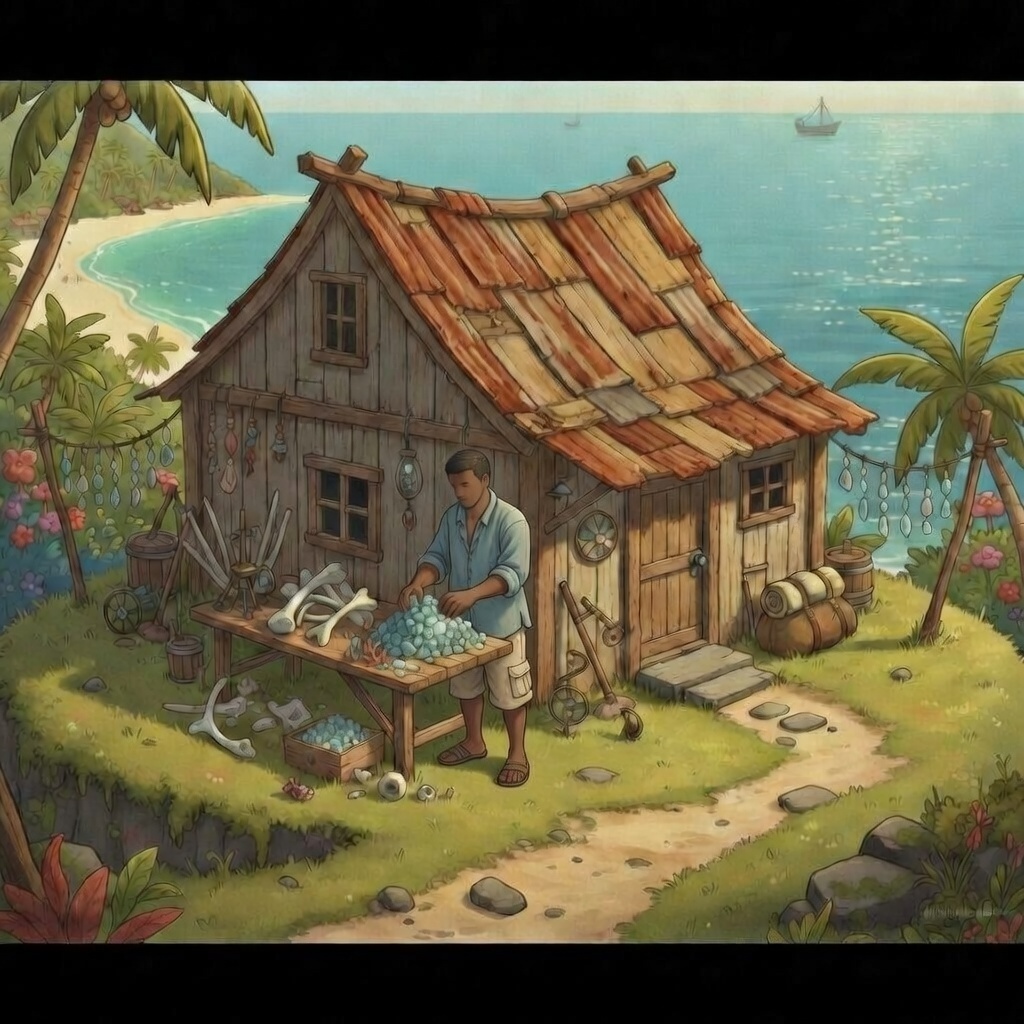
Lately, he had been scouring the shoreline for sun-bleached whalebone and fragments of sea glass, shards the ocean had tumbled into soft, frosted jewels.
In the evenings, within a creaking shack just a stone’s throw from the surf, he worked by candlelight. He sorted his findings into two piles: one to be melted or carved into implements of unusual shape and colour, the other to be kept in case they inspired some future, as yet unnamed invention.
“Utility is the only currency here, Gerdy,” the elders would scoff, their voices as hard as the local granite. “Pretty trinkets don’t fill a belly or keep out the storm.”
Their words stung. On some nights, staring at his designs, Gerdy felt less like an artist and more like a madman trying to move a crowd by playing an air guitar. He longed to create something both meaningful and beautiful, something to nourish the soul as well as the eye. Yet he found himself drifting between the spark of new ideas and the weight of old doubts.
One afternoon, a travelling merchant arrived. He had a calm, steady face, like the surface of a quiet lake, and eyes that held the confidence of one who had sailed the world and seen its many faces.
He passed by the stalls piled high with rope and barrels of brine, ignoring the useful tools the others admired. Instead, he stopped at Gerdy’s modest table, where the glass and bone caught the sunlight and flashed like fire.
“This catches the light in an extraordinary way,” the merchant said, turning a piece of frosted glass between his fingers. “It’s like a kaleidoscope. I could hang this outside to delight the children, or perhaps to startle the pests away.”
“I’m glad you see a use for it,” Gerdy replied, forgetting to play the part of a salesman and instead speaking from the heart as he looked down at his calloused hands as though they were evidence of a crime.
The merchant paused, still examining the glass. “I once knew a man,” he began, his voice dropping to a confidential hum, “who lived his life entirely by his watch. Every action was timed to the second. His days were full, his work impeccable, and his village admired his steadiness. Yet inside, he was a hollow man. He had no inkling why he did what he did.”
He looked Gerdy in the eye. “That was until he travelled to a hidden grove, a place that exists in a state of constant autumn. There he finally learned what his heart had been longing for.”
“And what was that?” Gerdy asked.
The merchant looked away, a small, knowing smile tugging at his mouth. “Never mind that. The real question is, do you know what your heart is longing for?”
Gerdy studied the deep lines on the man’s face and noticed a trace of blue ink peeking from beneath his sleeve: the tail of a drawing not fully concealed.
“That man you knew,” Gerdy said slowly, nodding towards the ink, “did he tell you where that place was?”
“Indeed,” the merchant replied, leaning closer. “Some people throw themselves back to the shore after the first rough wave; they keep their edges sharp and call that strength. Others stay in the water long enough to be changed, even if they cannot yet see what they are becoming.”
He reached into his cloak and produced a small, folded map drawn in blue ink. It depicted simple trees encircling one towering, ancient trunk. “This is the way to the hidden grove,” he said. “Follow the old river road until the stone bridge breaks. When the path refuses to stay straight, keep going.”
He tapped the paper. “In a clearing where a great sequoia leans over the world, you’ll find the wise one who can untangle the questions of your heart.”
Gerdy looked at the map. For a fleeting moment, he imagined tucking it away and returning to his stall, back to the familiar rhythm of quiet work and quiet shame. If he left, his shack would stand empty, collecting salt and cobwebs. If he stayed, the map would nag at him like a tide he was pretending not to hear.
Sensing his hesitation, the merchant placed a hand on Gerdy’s shoulder. “Keep it. Go and find what else you might be. Just because you’re used to where you are doesn’t mean it’s where you belong. And when you’ve found your answer, pass the map to someone else who needs it.”
With that, the merchant paid for the piece he had been admiring and departed, leaving Gerdy alone with the fading light.
As the sun dipped toward the horizon, Gerdy gathered his wares, now glowing a deep, fiery orange, and tucked the map into his tunic.
That night, after the village sank into its heavy, practical sleep, Gerdy lay awake, replaying the merchant’s words.
“What my heart is longing for,” he murmured. “What I might be. Where I belong.”
He made his choice. He packed a few provisions and a handful of his favourite glass fragments, then slipped out of Staple Green at dawn, leaving before the world fully awoke.
Find part 2 here
If something in this story sat with you, there’s more where this came from. Similar moments, questions and characters show up across three collections. Each one goes a little deeper.
Vol 1 — seasons, angels, and the art of living
Vol 2 — nature, history, and what echoes
Vol 3 — the mind, the mirror, and what we imagine
Leave a Reply