

Most of us have been in that room. Or on that call. The interviewer asks one of their stock questions: “tell me about a time you faced a significant challenge.”
I’m willing to bet that your answer is right there, already thought out, rehearsed, ready to go.
Now try to remember the last time you solved something cleanly. Quickly. The right idea at the right moment, no drama, no ordeal. Something that just worked.
That one’s harder to find, isn’t it?
Nobody ever leans forward and asks: “tell me about a time you found a simple solution to a problem.”
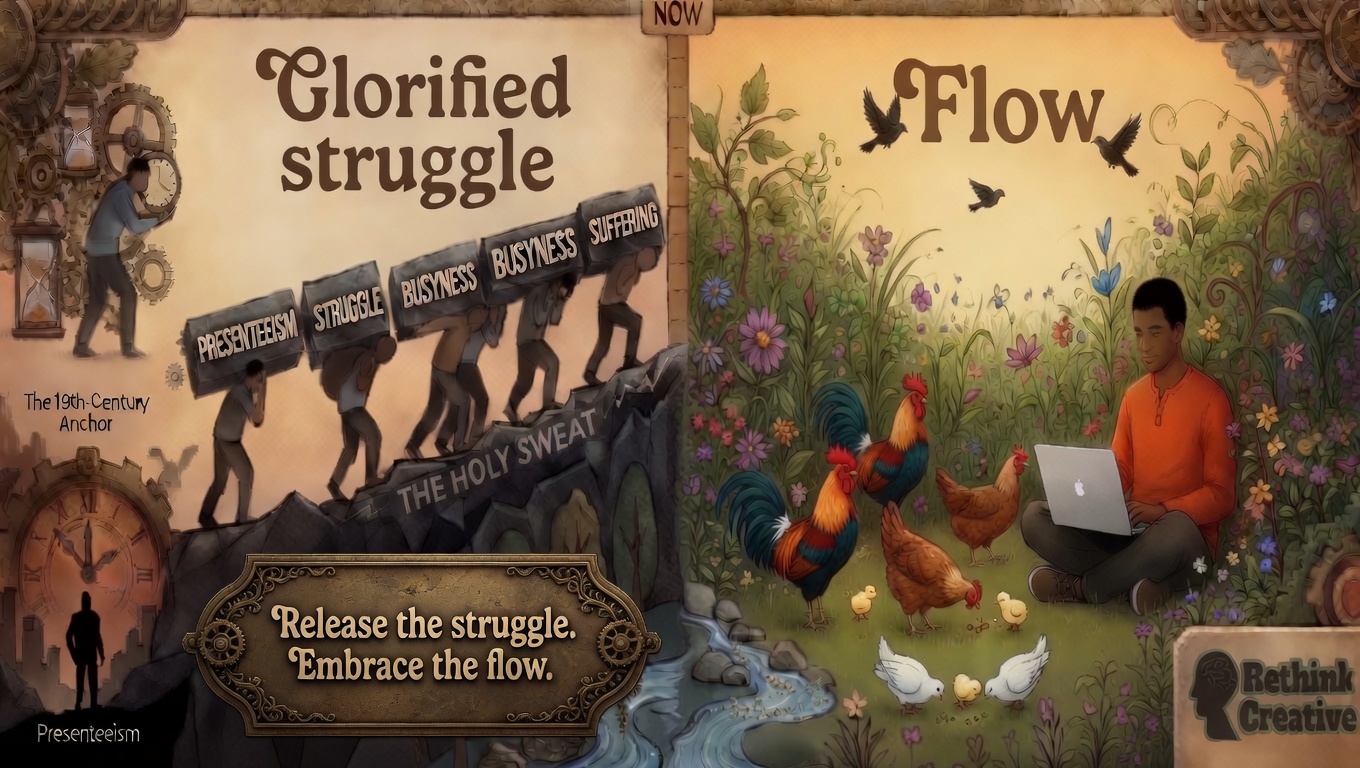
We’ve been trained to file our suffering and derive worth from it.
However, the job interview didn’t create the conditioning out of thin air.
It stems from a belief system we were handed so early we stopped calling it a belief. We call it common sense.
The system was not designed for you
I spent years in jobs where visible effort was the currency. You were quietly discouraged from leaving on time, not because the work wasn’t done, but because not staying looked bad.
You’d be forgiven for thinking it’s just a marginal office culture phenomenon, but it runs deeper than that. The glorification of struggle is like a voice in our own heads that we mistake for our own.
The Holy Sweat: It has deep roots
This isn’t new. Jacob, the bible character, wrestled with an angel and received a blessing. The story -and others similar to it- gets misread as proof that struggle itself is the source of reward, that if you suffer enough, the blessing automatically follows. That was never the actual point of the story. But misreading it is easy.
Another misreading. Being stoic has come to mean being unfazed under hardship. It’s emotional suppression dressed up as strength. But the Stoic goal was never to feel less under stress, and derive a sense of superiority from it. It was not to be controlled by what you feel. That distinction got lost somewhere between ancient Greece and the modern productivity influencer.
Different centuries. Same sentiment: if it came easily, it doesn’t count.
Three ways the glorification of struggle has trapped us:
1) When effort is the measure of legitimacy, efficiency feels like cheating, so it has to be hidden. The person who solves in an hour what takes others a day is incentivised to perform the struggle because the longer something takes, the more it must be worth.That logic is baked into how value gets perceived. It’s one of the many remnants of the industrial age. The incentive is therefore: take longer. Make it look like you struggled.
2) The sunk cost misery. In fields like law, medicine, and academia, seniors often feel obliged to pass the same misery onto their juniors. This doesn’t persist because it produces the best outcomes (how would they know, they haven’t tried any other way), but I would argue it’s often because the people who survived it need to feel it was a necessary rite of passage. If the process is made easier, it retroactively devalues their own struggle. So to keep their own scars from feeling pointless, they demand the next generation pay the same unnecessary price.
3) The romanticisation of creative suffering. The artist who finds an audience gets called a sellout, simply for evolving, for reaching people, for trying something new. The starving artist image dies hard. And it has teeth: it polices ambition under the guise of authenticity. The implication is that real work should cost you, and the moment it starts paying, something has been lost.
There’s a legitimate version of that concern. But most of the time, it’s just archaism dressed as morals.
There is another way
We could swap the theatre of the holy sweat for flow: aiming to reach being in the zone, this state where time dissolves, the self loosens its grip, and challenge and skill lock so perfectly that effort stops announcing itself. The work begins to do itself. No struggle required. No wounds to display.
This is the state the old system needs but fears most because the dividends it pays cannot be easily quantified or measured by the clock. The holy sweat is a holy equation: what gets measured gets managed. No measure = no management = chaos.
Except that the equation rests on a false proof; it assumes that what is invisible is also nonexistent.
The question that changed things for me
I wasn’t the one staying late for show. I took work home quietly. I trained people on top of doing my own job, refusing to be totally consumed by the metrics. I refused to perform busyness because it felt dishonest, and because I wasn’t built for it.
What I didn’t understand then was that in a system that rewards visibility, invisibility is penalised, even when the work is good. It’s about perception. And here is where it gets absolutely ridiculous:
If nobody saw you struggle, if nobody saw you sacrifice, go above and beyond, or if you modestly refused to take credit, the assumption will be that it was easy for you. And if it was easy, it mustn’t be worth much. Despite deserving recognition, you’d be more likely to be passed over for a promotion…or worse.
The result? People noticed the pattern and adjusted. They did less but looked busier. Played the game, controlled the perception, the narrative. The system got exactly what it was looking for and kept looking for more of it… Holy sweat. By the bucket load. Sorry for the image.
That was a design flaw I kept trying to work around by working harder, as if doing more of the same would eventually be seen. Noble? Maybe. Naive? Yes, and very expensive. I paid in time, in energy, in health, and in the slow erosion of believing that doing good work should be enough.
Doing good work should be good enough. Being conscientious should be rewarded in all strata of society. But that’s not what we see.
What finally moved things for me wasn’t more effort. It was the moment I stopped asking how hard I am working and started asking how I can work smart instead of just hard.
Every institution you encounter has interests that are not the same as yours. A system exists to perpetuate itself, to manage people, average them out, and keep them where it needs them. Once you see that, the question changes.
Not: did I earn this through struggle? But:is this even the right thing to be doing? And:is there a way to do this more efficiently?
That question sounds deceptively simple. But answering it honestly means accepting that the system you operate in was designed with interests that were never the same as yours. That the rules you were following were written by people who needed you to keep following them. That the voice telling you to stay later, to be seen struggling, to perform sacrifice: that voice was not your conscience. It was the institution’s, living rent-free in your head.
Seeing that is not an excuse for opting out of everything hard. Hard things will still find you. But once you see the architecture, you stop paying the unnecessary tax. You stop performing a struggle that nobody who matters is watching. You stop favouring the hard way over the smart way.
The struggle, when it comes, should be a tax you pay only because you must. Not an overdraft you overuse and brag about, as if living in the red deserves a badge of honour.
You should start building something that actually fits the way you think, that flows better. That is what this space is about. A clearer view of the machinery, so you can make deliberate choices about which parts of it you actually want to operate inside.
Reflect. Redefine. Rise.
Rudiano
If this piece opened something for you, my post on Substack takes it further and provides another reason to rethink our approach to work.
Leave a Reply