

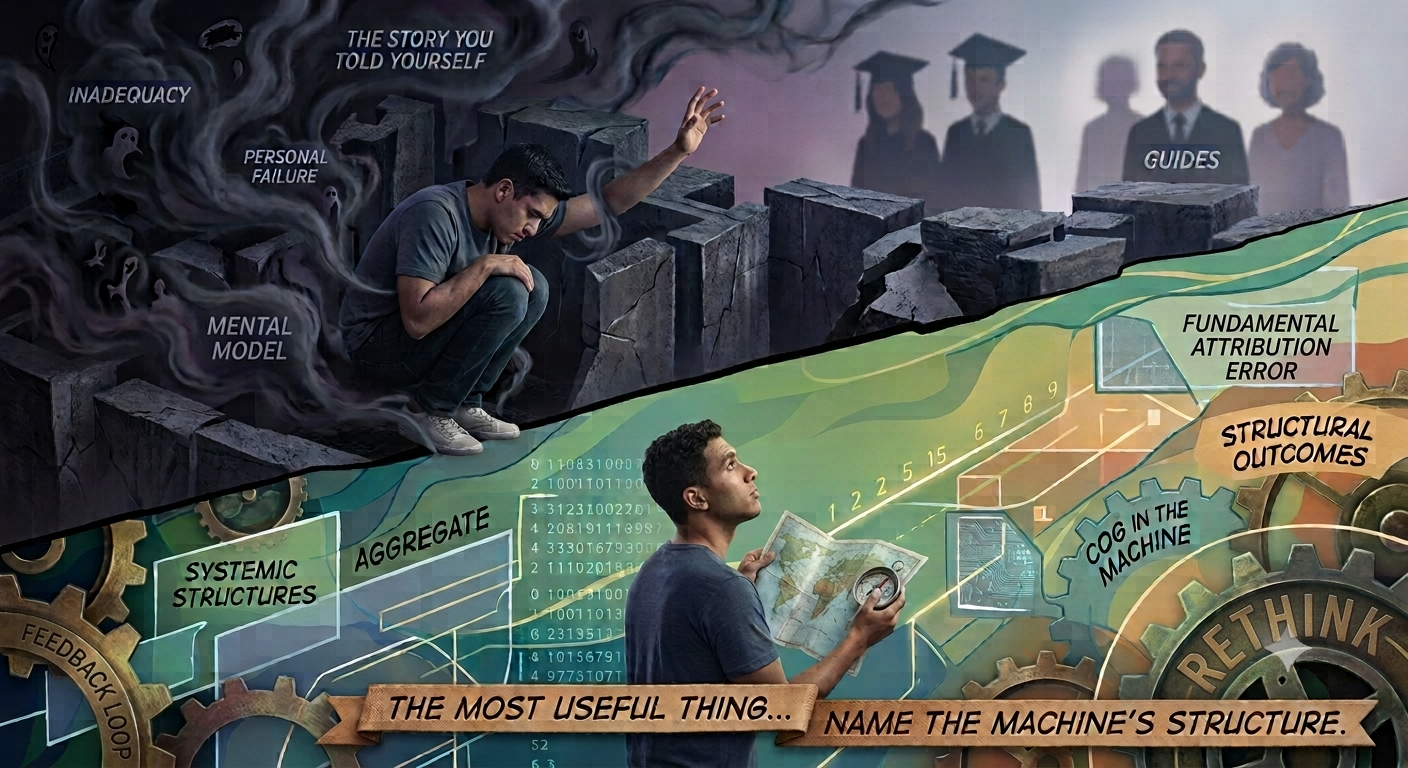
There is a story you tell yourself to make sense of things.
School didn’t prepare you for the real world. Then the real world promised guides, but the guides were hard to find, and when you found them, they didn’t know your terrain.
So the structure fails you quietly, repeatedly, and the story writes itself: the problem is me. I wasn’t attentive enough. Smart enough. Resilient enough.
Let’s question that narrative.
Why does the story always find fault with you? There is a name for that reflex your mind performs. Psychologists call it the fundamental attribution error: the tendency to explain someone’s outcome by their character, and to underweight the situation they were in. So the anxiety, the burnout, the promotion going to someone else, or the layoff…All become signs of our inadequacy alone. Even though the system may have had the biggest part to play.
The structure is silent about its own failure, so the gap gets filled with the only explanation your mind has on hand. You end up carrying what was never yours to carry.
Your mind runs on a mental model, a working theory of how the world operates that you use, mostly without noticing, to interpret everything that happens to you. If personal responsibility is the only model you were ever given, every structural outcome gets filtered through it and comes out the other side looking personal.
Ask yourself: when the promotion went to someone else, was there ever a version of that story that didn’t lay the blame on you? If not, that’s not because there wasn’t one. It’s because your model didn’t have room for it. It operated under the assumption that you were responsible for absolutely everything in your life.
I told versions of that story to myself for the better part of twenty-five years.
The less obvious story, but the truer one, is that we can not control everything; the structure we operate in is optimized for the aggregate: the big data, the big narrative, the big number, the politics.
Do you know the concept of suboptimization? Suboptimization occurs when one specific part of a system is optimized so intensely that it actually ends up damaging or degrading the performance of the entire system. An example you might have seen over and over again: a system ends up improving its overall numbers by sacrificing the parts that make it up. The company hits its targets. The department clears its budget. The individual ends up as collateral damage. It is a pawn. A number on a spreadsheet. The priority is whatever makes the figures look.
Doesn’t that change the question? It stops being “what’s wrong with me.” It becomes “what was this system built to optimize for, and was I visible inside that calculation?”
The shift to seeing it doesn’t happen on its own. It usually arrives later, once there’s enough distance from the experience to look at it without the original weight attached.
Here’s the reason why the old story stats alive long after the event itself is over: a feedback loop. Every time you absorbed a structural failure as personal, you behaved differently in the next round. Working harder but fearful of making any waves. Less willing to ask for what you were worth. More invisible. That changed behavior produced new outcomes that looked, conveniently, like more proof you were right about yourself, that there is something wrong with you, that no matter what you do, things rarely pan out as you hoped.
But this loop wasn’t showing you the truth. It was showing you the consequences of believing a wrong theory, fed back to you as if they were evidence. The truth is that the system had just conditioned you to become even more invisible. That’s what it does. It likes you invisible so you are more manageable and expendable.
But now that you see the system for what it is, what it does, you can stop blaming yourself for its own flaws.
The events don’t change. Your relationship to them does. You stop feeding a broken model the same faulty inputs.
You see, the old story was never objective. It was just the only mental model available at the time, running on a loop that mistook its own consequences for confirmation.
It changes what comes next, too. You accept that you’re a cog in a machine, but you’re aware the machine doesn’t automatically know what any given cog does. Each cog has to document its own weight and make the machine aware of it. The machine runs on numbers, plays, counterplays, narratives, interests: the aggregate it was built to optimise. You have to learn its language before you can be seen inside it.
This is what I’ve come to realize: that one of the most useful things one person can do for another is describe the machine’s structure clearly enough that the old story loses its grip. Rethink the attribution. Rethink the model. Rethink the loop you’ve been standing inside and reclaim your agency.
If I’ve named something you’ve been carrying, there’s further to go. The map extends. So does the conversation. I go deeper here.
Reflect, redefine, rise!
Rudiano
Leave a Reply