

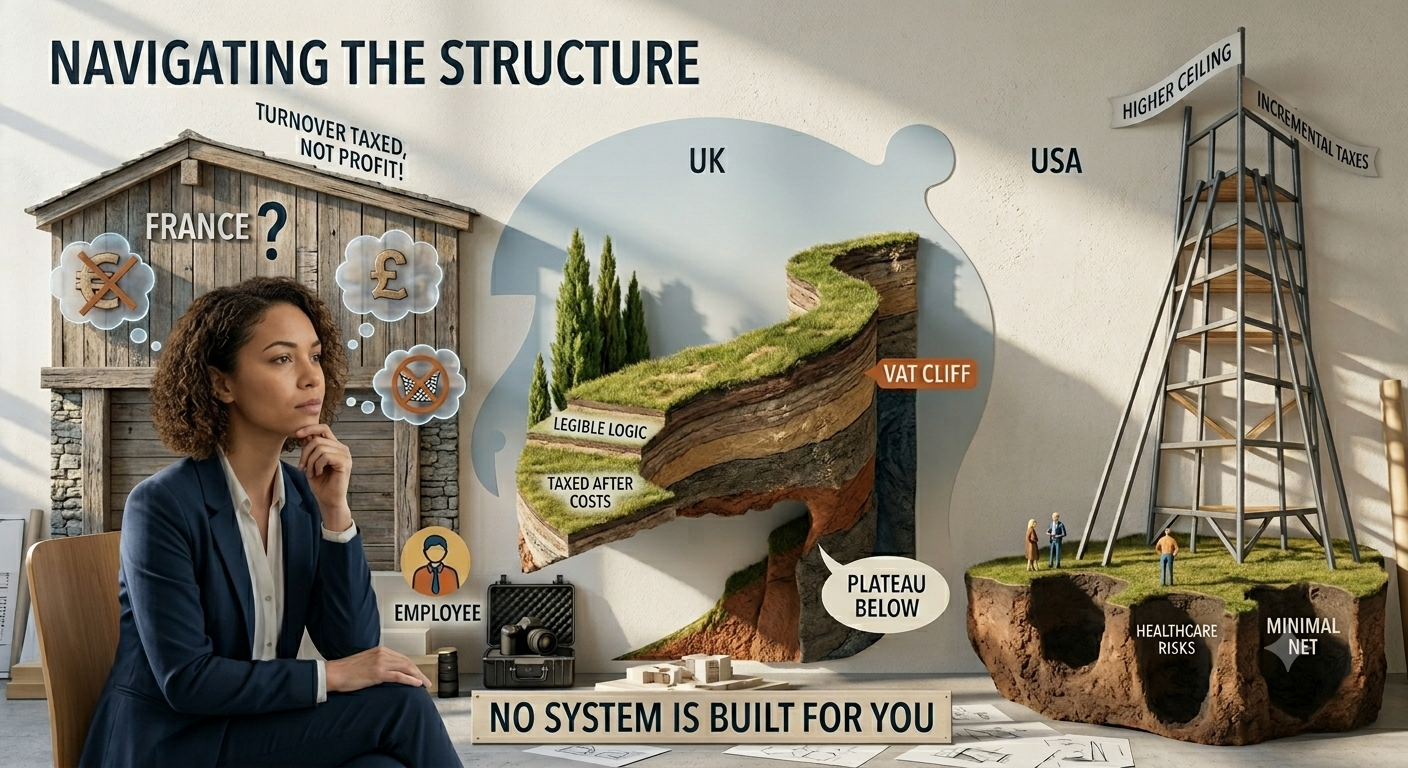
I was a sole trader in the UK for years. It wasn’t exactly simple, but its logic was legible. You build something, and you get taxed on what it earns after costs are deducted. The structure had friction, but it had a shape you could work with.
When I looked seriously at continuing that in the French system, the shape changed entirely. France is not designed with small and medium enterprises in mind. It seems built around the protection of employees, and that protection, generous and real as it is, has a cost. If you work but are not an employee, you carry that cost yourself, and it’s quite heavy.
The most common entry point for freelancers in France is the Micro-Entreprise regime. On the surface, it looks like the UK counterpart: simple registration, low administration, and easy to start. But a significant difference is that you are taxed on your turnover, not your profit. If you earn €30,000 and spend €15,000 building the thing that earned it, you still pay social charges on the full €30,000 (with a little bit of a rebate), but the laptop, the software, and the professional insurance are not deductible. The state takes its percentage regardless of your actual costs.
That’s worrisome. Better have very lean overheads.
The structure also has a ceiling. Exceed the Micro-Entreprise turnover limit two years running, and you are pushed out of the regime entirely, into a standard company structure with a significantly heavier administrative and tax burden. For a solo operator, crossing that line by a small margin can result in less net take-home than before you crossed it. The system doesn’t aim to punish ambition, but the reality is that it makes ambition inconvenient past a certain point.
The UK has its own version of this. Every sole trader learns to fear the VAT threshold, currently set at £90,000 (roughly €106,000 / $114,000). Cross it by a single pound, and you must register for VAT, which either makes your services 20% more expensive to non-business clients, or it eats directly into your margins. Business clients can reclaim that 20% from the state, so for them the cost is neutral. But you cannot always pass it on, and not every client is a business. One pound over the line and the arithmetic changes completely. Again, the rational response is to stay just below it. Not because you lack ambition. Because the structure discourages the next step.
This is a significant part of why French entrepreneurs leave. And why some UK sole traders plateau deliberately. The architecture penalises growth past certain points, and people respond to what the structure actually incentivises, not always what they want or are capable of doing.
The United States attracts for several reasons, in a nutshell, because it tends to facilitate becoming big. The federal tax system is more incremental, the cultural environment around building is more openly permissive, and the ceiling feels higher. Of course, the US carries its own trade-offs. It is not a cleaner system. It has a different set of constraints.
No system is built to serve you unconditionally. The French system was built to protect the worker. The entrepreneur is not its target. They are collateral damage of a structure optimised for a different person entirely. Not targeted. Not punished. Simply not a priority.
The person who leaves France to build a business is responding to a structure that makes specific demands on someone in their position. The person who stays and struggles is not less capable. They may simply not have been shown what they were dealing with.
In any case, knowing which system you are inside, what it costs, what it rewards, and what it penalizes is not cynicism. It is doing your due diligence. And as far as France is concerned, suffice it to say that it isn’t exactly rolling out the red carpet for you if you are after tax savings. Destinations like France and its overseas departments (Guadeloupe – where I now live, Martinique, French Guiana, Réunion, Mayotte) are more about the lifestyle, culture, and language. Not about money savyness.
Leave a Reply