

Let me ask you something: when was the last time you questioned why you work the way you do?
Not whether to work. We all know we have to eat. But the form your work takes. The career path you chose, or perhaps the one that chose you. Have you ever stopped to wonder whether that path was truly yours, or whether it was simply the most logical response to the world you were born into?
Because here is what history keeps trying to tell us, if we’d only listen: the “right” career has never been a fixed truth. It has always been a reflection of its time.
And once you understand that, the pressure to follow a single conventional script starts to loosen its grip.
The Village Silversmith Didn’t Choose Passion. He Chose Survival and Found Mastery.
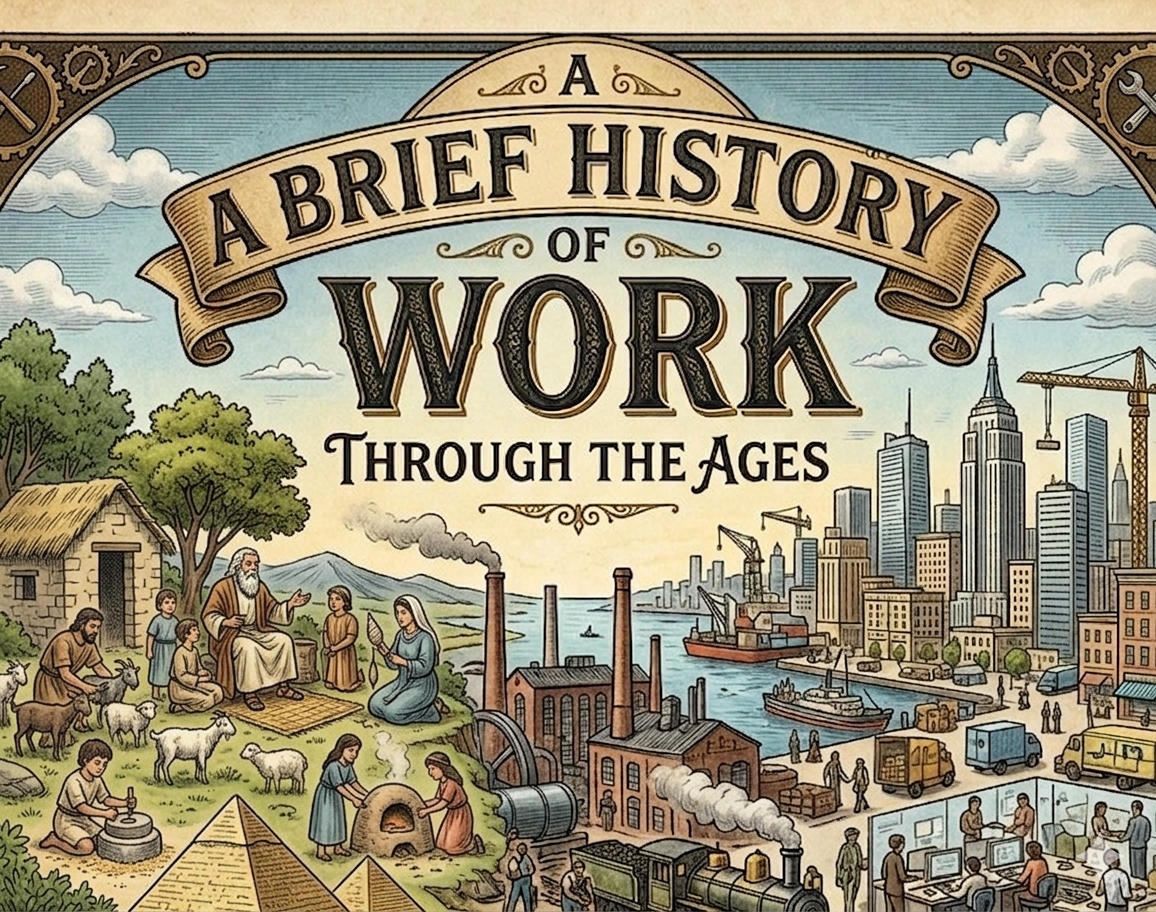
Before factories, before corporations, before job titles existed on LinkedIn, work was radically different. We’re talking about a world where your profession was not just what you did, it was who you were. In fact it was more often than not a family affair.
The village silversmith. The baker. The fish monger. The blacksmith. These weren’t jobs you applied for with a CV. They were identities forged through years, sometimes decades, of hands-on learning inside the guild system.
From the 12th century onward, guilds were the backbone of economic life in Europe. They were part trade association, part civic institution, part moral code. Blacksmiths, bakers, masons, cordwainers, each operated under strict rules governing quality, conduct, and professional ethics. You couldn’t just set up shop and call yourself a silversmith. You had to earn it.
The silversmith in particular holds a fascinating place in this history. For centuries, before stable banking existed, wealthy families stored their liquid wealth in plated silver candlesticks, bowls, dishes. The silversmith was not only a craftsman but also a metallurgist, an artist, and a trusted custodian of a family’s fortune. He melted foreign coins brought by sailors, worked the metal through annealing and hammering and handed back something that held both beauty and value.
That is a multi-dimensional expertise we rarely demand of a single professional today.
And here’s the key thing: this was one of the most prestigious careers of its era because the socioeconomic structure of medieval Europe meant that mastery within a guild system was the most reliable path to social standing, fair wages, and a life of relative security. Not so much nowadays.
The context shaped the choice. It always does.
The Great Disruption: When the Rules Changed Overnight
Then came the Industrial Revolution and everything was thrown into the furnace.
The guild system, centuries old, was dismantled by economic force. Machines could produce at scale what a master craftsman could not. The premium on individual mastery collapsed. The market now favoured consistency and volume over the hallmark of a trusted artisan.
Waves of people left the countryside and flooded into cities. They traded the identity of the craftsman for the anonymity of the factory floor. The relationship between worker and product was severed. You no longer made the thing, you performed one small step in making the thing, thousands of times over.
Was this a step backward? In some ways, yes. But for millions of people emerging from feudal poverty, it was also an economic lifeline. The factory, for all its dehumanisation, offered a wage. And a wage meant independence from the whims of a landowner.
Again: the socioeconomic context shaped what counted as a wise move. The person who clung to artisan ideals when the factories came may have felt noble. But the reality is they likely ended up going hungry.
Blue Collar, White Collar and the New Hierarchy
As industrial capitalism matured, a new stratification emerged. Work began to divide itself into what we came to call blue-collar and white-collar.
Blue-collar workers operated with their hands in factories, on construction sites, in mines. White-collar workers operated with their minds in offices, behind desks, managing numbers and correspondence and the growing complexity of corporate life.
And with this division came a new hierarchy of prestige. The clerk, the manager, the executive…These became the aspirational figures of the 20th century. The advice handed down to millions of children across the Western world was clear: stay in school, get a degree, wear the suit, climb the ladder.
For a good stretch of the 20th century, that advice wasn’t wrong. The post-war economic boom created an expanding middle class in which a university education genuinely opened doors. Corporations offered salaries along with pensions, job security, a defined arc from junior to senior. The social contract between employer and employee felt real, even sacred.
So parents pushed their children toward law, medicine, accounting, engineering because the economic conditions of the time made them the most reliable vehicles for stability and social mobility.
Context. Always context.
The Knowledge Economy and the Freelance Revolution
Then, somewhere around the turn of the millennium, the ground shifted again.
The internet arrived and began dissolving the walls of the old corporate citadel. Suddenly, a person with a laptop and a skill could reach a global market from a bedroom. The freelance economy exploded. Platforms emerged to connect talent with work across borders. The idea of a “portfolio career“, multiple income streams, multiple identities, fluid movement between projects.. It all stopped being eccentric and started being aspirational.
The old advice “one employer, one pension, one trajectory ” began to look less like wisdom and more like a dream. Corporations discovered “restructuring.” Pensions were quietly replaced with defined contribution schemes that put the risk squarely on the individual. Job security, that 20th-century promise, started to feel like a relic.
And so a new set of career wisdom emerged: build your personal brand. Develop transferable skills. Design your own offers. Own your audience. Multiple income streams are not a sign of instability, they are the intelligent response to an unstable world.
Was this universally correct advice? No. Context still mattered enormously. If you were raising a family in a high cost-of-living city, the freelance life carried very real risks. If you were young, mobile, and digitally native, it offered extraordinary freedom.
The point is not that one model was right. The point is that the model you chose had to fit the economic reality you were living inside.
Context remains key!
And Now? The Age of the Algorithm and the Question We Can’t Avoid
Here we are. 2026. Artificial intelligence is not coming. It has already arrived.
Tasks that once required years of training, such as drafting legal documents, generating design concepts, writing code, analysing data sets, can now be initiated by a well-crafted prompt (or increasingly by just asking the question in natural language)
The question of which cognitive work remains distinctly human is being renegotiated. Who would have thought?
And I’ll be honest with you: I find this both fascinating and unsettling.
Because we are at one of those hinge moments in history like the emergence of the guilds, like the Industrial Revolution, like the digital disruption where the old career scripts are being shredded and the new ones haven’t fully been written yet.
What I do know, from researching this history carefully, is this: the people who navigated transitions well were rarely the ones who clung to the old prestige hierarchies. They were the ones who read their moment honestly and adapted as best they could.
The craftsman who retrained to work on the factory floor. The factory worker’s child who pursued the white-collar path when it opened. The corporate professional who built a freelance practice when the internet made it viable. Each was making the same essential move: a lucid, clear-eyed reading of their economic context, followed by a deliberate choice.
That is what this moment demands of us too.
What This Means For You, Right Now
I’m not going to sit here and tell you that AI means you should all become prompt engineers or pivot to creative work or double down on the trades. That kind of one-size-fits-all proclamation, likely won’t age well. Everything is still in flux.
What I will say is this:
The career path that made sense for your parents was shaped by their world. It was a rational response to their economic conditions, their available opportunities, the social structures that rewarded certain choices. Honour that. Don’t dismiss it.
But don’t be enslaved by it either.
Your world is very different. The socioeconomic context you’re navigating (gig work, AI disruption, remote possibilities, the collapse of traditional gatekeeping in many industries, and the simultaneous rise of new barriers in others) demands its own honest assessment.
Pay attention to what direction things are going in and ask yourself where that intersects with what you can genuinely offer.
It’s the question the freelancer building a global audience from a laptop in Guadeloupe is asking.
It’s a question, I feel, that has always led people toward the right work, their right work, at the right time.
.
If this resonated, subscribe to the newsletter for more insights
Reflect. Redefine. Rise
Rudiano
Leave a Reply